Block landing · deciduous tree cad block
Free deciduous tree CAD blocks for AutoCAD
By Saumyajit Maity · Published 4 Jul 2023 · Updated 22 Jan 2026
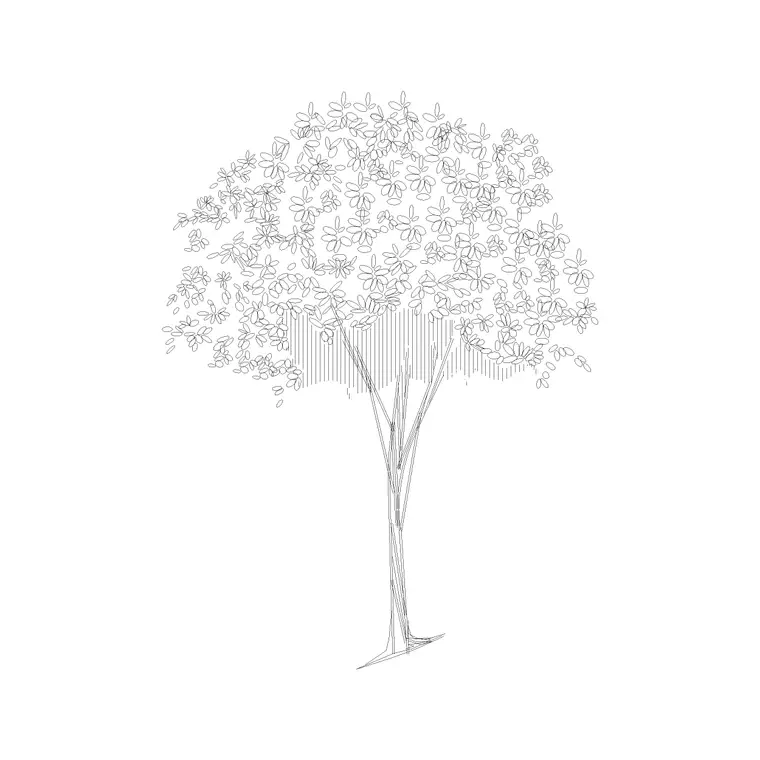
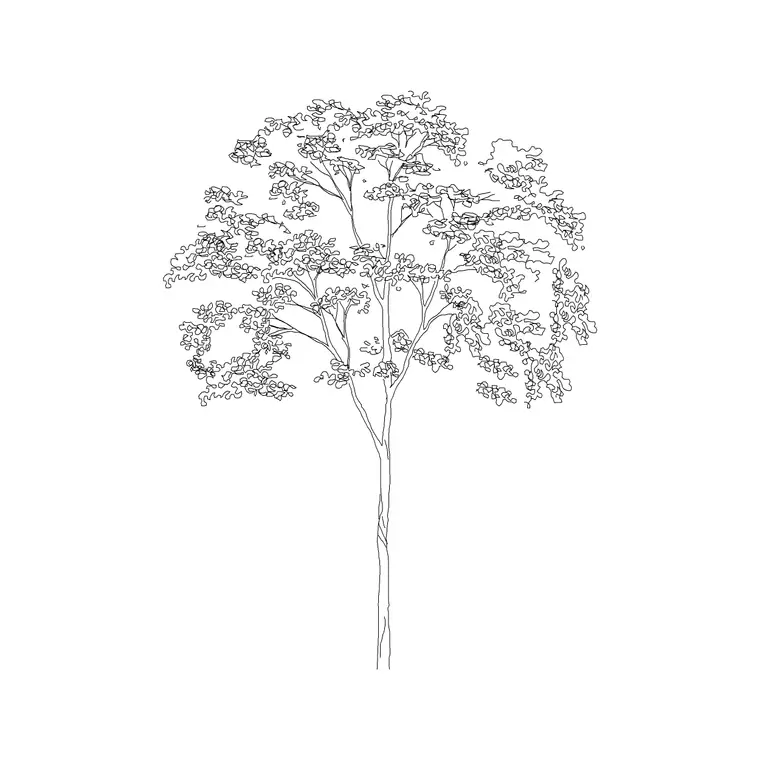
Deciduous trees — the broadleaf trees that leaf out in spring and drop their leaves in autumn — are the workhorse of most temperate planting schemes, and they get a block of their own. In elevation a deciduous tree is a rounded, spreading canopy on a clear trunk; in plan it is a broad, often lobed circle. What makes them distinct from conifers is seasonality: the same tree looks completely different in summer and winter, and a good deciduous block lets you show both. This page collects free deciduous tree CAD blocks in DWG and DXF, drawn to scale and ready for AutoCAD 2004 or later, free for personal and commercial use with no signup or watermark.
That seasonal swing is the whole reason designers reach for deciduous trees. They give shade and screening in summer, then drop their leaves to let low winter sun through to a façade or a garden. A drawing that can show both the full-summer canopy and the bare-branch winter structure is making an argument about comfort and daylight, not just decoration.
What defines a deciduous tree block
A deciduous block shows a broadleaf canopy — rounded, spreading, and usually broader than it is tall on a mature specimen. In elevation the trunk is shorter and the crown wider than a conifer; in plan the canopy is a full, often gently lobed circle rather than a tight spiky one. The trunk and main branch structure are typically drawn separately from the foliage outline.
That separation is the key feature. Because the foliage sits on its own layer, one deciduous block can show two states: a full leafy crown for summer, and — with the foliage frozen — a bare branch structure for winter. That single ability is what makes deciduous blocks more versatile than evergreens, and it is built into the blocks here.
Summer canopy and winter branch views
The defining trick with deciduous trees is showing the seasons. In summer the tree is a solid, shading mass — draw it that way to demonstrate shade over a terrace or screening of a view. In winter the same tree is a tracery of bare branches that lets light through — draw it that way to prove that low winter sun still reaches a south-facing window the summer canopy would have blocked.
Keeping foliage and branch structure on separate layers means you flip between the two from one insertion: thaw the foliage for the summer plan or elevation, freeze it for the winter view. Designers use this constantly to argue that a scheme is comfortable in both seasons, and clients find the side-by-side summer/winter pair genuinely persuasive.
Deciduous tree dimensions to design around
Broadleaf trees spread. Use these reference figures: a small ornamental deciduous tree reaches 4–8 m tall with a 2–4 m spread, a medium tree 8–12 m with a 5–8 m spread, and a large shade tree such as an oak, plane or lime 15–25 m tall with an 8–15 m spread. Unlike conifers, a mature broadleaf is often as wide as it is tall, or wider.
That broad spread drives spacing. Lining deciduous shade trees down a street means allowing for crowns that will eventually touch and overlap — usually a generous spacing based on the mature 8–15 m spread, not a tight one. Size your plan circle to the design-year spread and the layout will reserve the right amount of ground for each crown.
Inserting and scaling the block
Deciduous blocks are drawn full size in millimetres. Set INSUNITS to millimetres (or insert at 0.001 in a metre drawing) so the tree lands at the right size. For elevations, snap the trunk base to your ground line; for plans, snap the insertion to the trunk at the canopy centre.
Because broadleaf trees vary so much, scaling is where you make them believable. Insert the block, then SCALE the crown to the species' design-year spread. Across a group, vary the scale and rotation slightly so the planting does not look stamped, and on an avenue allow the wide crowns room to grow into each other over time rather than spacing them as if they will stay small.
Where deciduous tree blocks are used
Deciduous trees dominate temperate-climate drawings: urban street trees, park and garden planting, residential gardens, school and campus grounds, and any scheme where summer shade and winter daylight both matter. They are the default broadleaf you place on a site plan, and the tree most likely to need both a plan and an elevation because they appear in both the layout and the streetscape.
Keep them on the planting layer, and pair these blocks with the conifer, ornamental and shrub blocks in the trees-and-plants category. A balanced scheme often uses deciduous trees for seasonal shade and structure, conifers for evergreen screening, and shrubs at ground level — and drawing each with the right block keeps the planting story legible.
Using deciduous trees to argue daylight and shade
The strongest use of a deciduous block is environmental, not decorative. Place a broadleaf tree to the south or west of a building and its summer canopy shades the façade through the hottest part of the year, cutting overheating; in winter the bare branches let low sun through to warm and light the same rooms. A drawing that shows the summer canopy on one sheet and the winter branches on another makes that passive-design benefit visible to a planner or client.
The same logic applies to outdoor space: a deciduous tree over a terrace or play area gives dappled summer shade and an open winter aspect. Because the blocks here separate foliage from branch structure, you can produce both conditions from one tree, which is exactly the evidence a sustainability or comfort argument needs.
Free download
Browse the full library — DWG & DXF, no signup.
Questions
Frequently asked
What is a deciduous tree block, and how is it different from a conifer?+
A deciduous block is a broadleaf tree with a rounded, spreading canopy that can be shown leafy in summer or as bare branches in winter. A conifer is a denser, conical evergreen that keeps its foliage all year.
Can I show the tree both with and without leaves?+
Yes. The foliage and the branch structure are on separate layers, so you can thaw the foliage for a full summer canopy and freeze it for a bare-branch winter view, both from the same insertion.
Are the deciduous tree blocks free for commercial use?+
Yes. Every deciduous block downloads free in DWG and, where available, DXF, with no signup, no watermark and no attribution requirement, and is cleared for commercial project use.
How far apart should deciduous shade trees be spaced?+
Broadleaf trees spread wide — often 8–15 m for a mature shade tree — so space them generously enough that the crowns can grow to touch over time, sizing the plan circle to the design-year spread.
Related downloads
Blocks for this guide
Related categories
Related guides
Block landing
Free Flower Plant CAD Blocks — DWG Download
Free flower plant CAD blocks in DWG and DXF — flowering annuals and perennials in plan and elevation for AutoCAD landscape plans. No signup, commercial OK.
Block landing
Free Flowering Shrub CAD Blocks — DWG Download
Free flowering shrub CAD blocks in DWG and DXF — ornamental shrubs in plan and elevation for AutoCAD planting and site plans. No signup, commercial OK.
Block landing
Free Herb Plant CAD Blocks — DWG Download
Free herb plant CAD blocks in DWG and DXF — herbs for kitchen gardens, raised beds and planters, in plan and elevation for AutoCAD. No signup, commercial OK.