Block landing · basketball hoop cad block
Free basketball hoop CAD block in DWG and DXF
By Saumyajit Maity · Published 8 Dec 2024 · Updated 12 Feb 2026
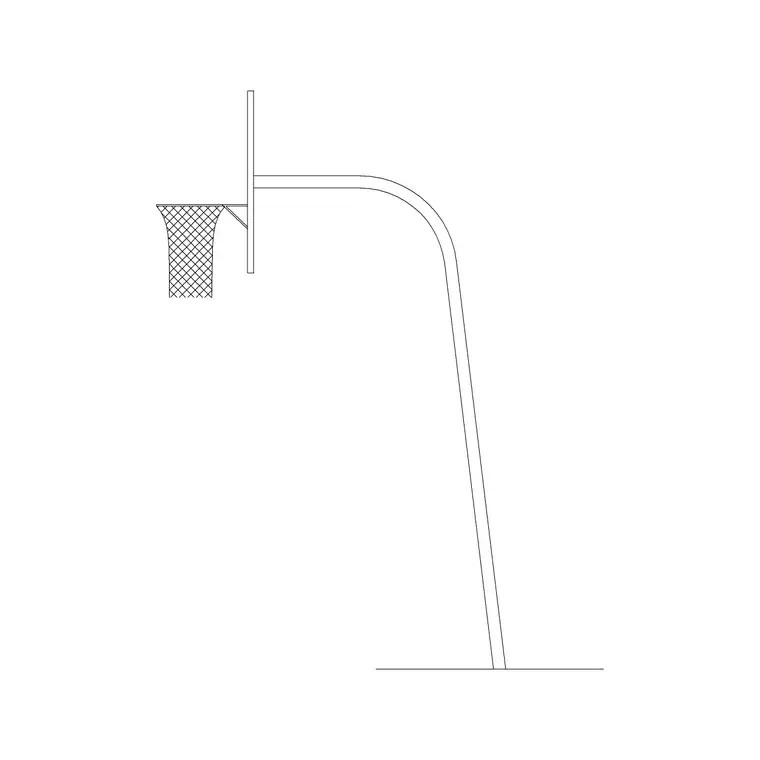
A basketball hoop is a height-driven element, so unlike most gym blocks it lives mainly in elevation: the rim sits at a regulation height, the backboard hangs above it, and the post or wall mount reaches up from the floor or out from the structure. A scaled basketball hoop CAD block lets you set that geometry correctly on a sports hall section or a court elevation. This page offers a free basketball hoop block in DWG and DXF, drawn to true millimetre dimensions in plan and elevation, ready for AutoCAD 2004 or later — free for personal and commercial use, no signup, no watermark.
The hoop is one of the few sports blocks where getting the height right is the whole point. A basketball rim sits at a standardised 3.05 m (10 ft) above the floor, and the backboard and overhang above it follow fixed proportions, so the block earns its place by carrying that geometry so you do not have to reconstruct it on every court drawing.
What's in the basketball hoop block
The elevation shows the backboard, the rim, the net and the support — either a freestanding post with its base, a wall-mounted bracket, or a ceiling-suspended frame. Because the rim height is fixed, the elevation is the view that matters: it sets the rim at the regulation level and shows the backboard and any overhang reaching above it.
The plan view is simpler but still useful: it shows the backboard and rim projecting over the court, and the post or wall-mount footprint, so you can set the goal back the correct distance behind the baseline. The support, the board and the rim sit on separate layers so you can show the structure on a fixing drawing and hide it on a clean court plan.
Regulation heights and sizes to design around
Basketball has well-known standard dimensions you can design against. The rim sits 3.05 m (10 ft) above the floor. A full-size backboard is around 1800 mm wide by 1050 mm high, with the rim mounted near its lower edge. The rim itself is around 450 mm in diameter. The board typically overhangs the court by a regulation distance behind the baseline.
Use these as your fixed reference points. The block is drawn so the rim lands at the regulation height, which means once you insert it at the right floor level the rest of the geometry — board, net, overhang — falls into place. Always confirm against the relevant governing body's rules for the level of play, but the standard figures cover most court drawings.
Elevation for the height, plan for the court
The hoop block is used mostly in elevation and section: a sports-hall cross-section showing the goals at each end at regulation height, or a court elevation for a presentation. The elevation is where you prove the rim height, the backboard clearance and that a suspended or wall goal clears the roof structure and any services.
The plan view drops onto the court layout to set the goal position behind each baseline and to show the backboard projecting over the playing area. On a multi-court sports hall, the plan lets you position practice goals down the side walls as well as the main goals at each end.
How to insert the hoop at the right height
The hoop is drawn full size in millimetres. Insert at scale 1 in a millimetre drawing, 0.001 in a metre drawing, or set INSUNITS to millimetres. The trick with the hoop is the Z level: for a section or elevation, insert the block so the rim lands at 3050 mm above the finished floor line, then the backboard and overhang follow automatically.
For the court plan, run INSERT, snap the base point to the goal position behind the baseline, and rotate so the board faces onto the court. Mirror the goal to the opposite baseline. Keep the goals on a sports-equipment layer so the court markings, the goals and the structure each read on their own drawing.
Where basketball hoop blocks are used
Basketball hoop blocks belong in sports-hall and gymnasium drawings, school and university sports facilities, leisure-centre multi-use halls, outdoor court and playground plans, and residential driveway-court layouts. Architects and sports-facility designers use them to set the goals at regulation height and to coordinate suspended or wall goals with the roof structure and the services above.
Because goals impose real loads — a suspended or wall goal needs proper structural support — the elevation block is useful on the structural coordination drawing as well as the GA, to show the fixing point and the load path. Pair the hoop with the wider fitness and sports blocks to fit out a complete sports hall.
Mounting types and how they change the drawing
The support type changes both the block you reach for and the drawings it appears on. A freestanding goal has a weighted or anchored base that projects onto the court, so its plan footprint and the run-off behind the baseline matter for player safety. A wall-mounted goal folds back against the wall when not in use, which is ideal for multi-use halls but means the elevation has to show both the playing and the folded positions. A ceiling-suspended goal hangs from the roof structure and often hinges up out of the way, so it lives on the section and the structural drawing as much as the court plan.
For a sports hall used for several activities, the folding and hoisting positions are not a detail — they decide whether the goals clear badminton, volleyball or five-a-side when basketball is not being played. Drawing each goal in both its deployed and stowed positions, on its own layer, lets a single hall drawing prove every configuration the multi-use brief asks for.
Free download
Browse the full library — DWG & DXF, no signup.
Questions
Frequently asked
Is the rim drawn at the regulation height?+
The block is drawn so the rim sits at the standard 3.05 m (10 ft) above the floor. Insert it at the right floor level on a section and the backboard, net and overhang follow automatically. Always confirm against the governing body's rules for your level of play.
Does the block include the support post and backboard?+
Yes. The block carries the backboard, rim, net and a support — freestanding post, wall mount or suspended frame — on separate layers so you can show the structure on a fixing drawing and hide it on a clean court plan.
What views does the basketball hoop block come in?+
Plan and elevation. The elevation is the key view because the hoop is height-driven; the plan positions the goal behind the baseline and shows the board projecting over the court.
Is the basketball hoop block free to use commercially?+
Yes. It downloads free in DWG and DXF with no signup, no watermark and no attribution, and it is cleared for commercial project use.
Related downloads
Blocks for this guide
Related categories
Related guides
Block landing
Free Gym Equipment CAD Blocks — DWG Download
Download free gym equipment CAD blocks in DWG and DXF — treadmills, weight machines, racks and benches in plan and elevation, AutoCAD 2004+, no signup.
Block landing
Free Treadmill CAD Block — DWG & DXF Download
Download a free treadmill CAD block in DWG and DXF — drawn in plan and elevation with the run-off zone, true to size for AutoCAD gym layouts. No signup.
Block landing
Free Exercise Bike CAD Block — DWG Download
Download a free exercise bike CAD block in DWG and DXF — upright, spin and recumbent bikes in plan and elevation, true to size for gym layouts. No signup.