Block landing · double palm tree cad block dwg
Free double palm tree CAD block in DWG
By Sumana Kumar · Published 10 Jan 2026 · Updated 12 May 2026
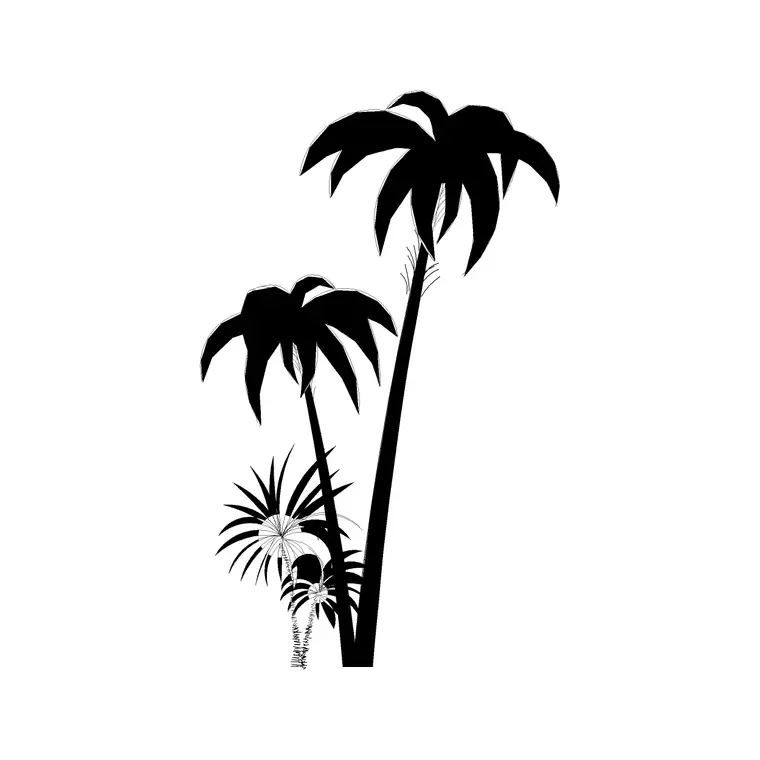
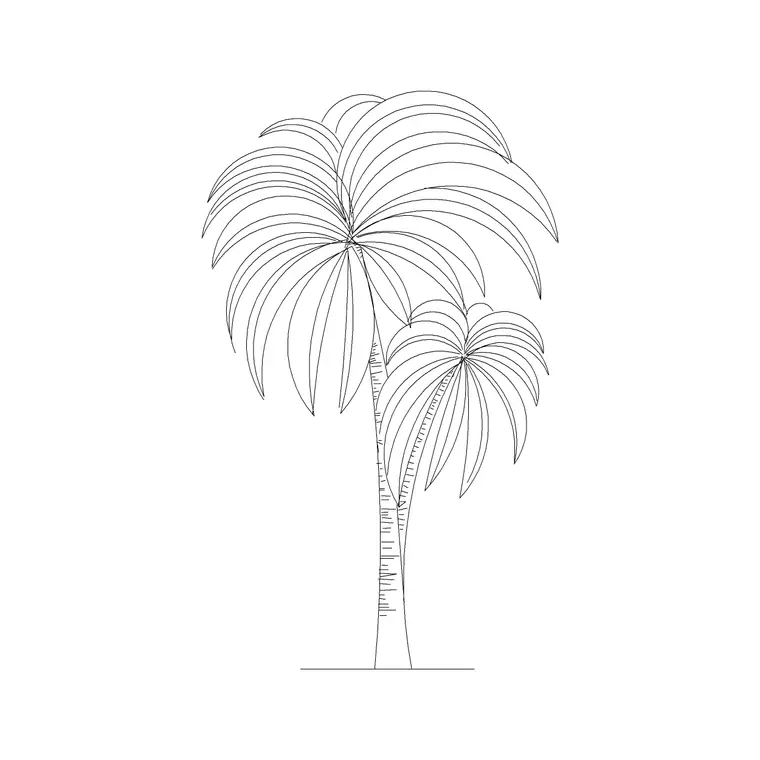
Download a free double palm tree CAD block in DWG — two palms grouped on a single trunk base, drawn in elevation with the slender trunks and fanned fronds that signal a tropical or resort setting. A paired palm reads as a designed feature rather than a lone specimen, making it ideal for entrances, poolsides and boulevard planting. Free for personal and commercial use, no signup, no watermark.
Flank an entrance, mark a poolside or punctuate a promenade with a paired palm, scaling it to the species you are showing. On a planting layer it freezes cleanly for a building-only elevation, and mirrors neatly to balance a threshold either side. Because the two trunks come grouped in one block, you never have to align a matching pair by hand, and every instance keeps the same considered composition.
What a double palm block gives you
A double palm groups two palm trunks rising from a shared base, often at slightly different heights so the pair looks naturally clustered rather than mirrored. This block captures that paired arrangement in elevation, with clean slender trunks, a ring of frond bases, and a fanned or feathered crown on each.
Grouping two palms in one block saves you placing and aligning them by hand every time, and guarantees the pair always reads as a deliberate composition. The two trunks and their crowns sit on shared planting geometry so the whole feature scales, copies and rotates as a single object.
Typical sizing for palms
Palms vary widely by species, but landscape and resort palms commonly read in the 4-12 m trunk-height range, with taller specimens going higher. The crown of fronds adds further height and a spread that is modest relative to the trunk. Scale the double palm block to the species and maturity your scheme shows, treating these as ranges rather than fixed numbers.
Because the two trunks differ slightly in height, scale from the shared base so both palms grow upward together and the pair keeps its natural, uneven look.
Inserting and placing the pair
The block is drawn full size in millimetres. INSERT at scale 1 in a millimetre drawing, 0.001 in metres, or set INSUNITS so AutoCAD rescales on insertion. Snap the shared base to your ground, planter or paving line.
Double palms work beautifully flanking an entrance — drop one on each side and mirror the second so the fronds fan outward symmetrically. Keep the palms on a planting layer with a lighter lineweight than the architecture, and freeze that layer when you want a clean elevation of the building alone.
Where double palms are used
Paired palms suit hotel and resort entrances, poolside and spa elevations, boulevard and promenade planting, and Mediterranean or tropical residential schemes. The grouped form has more presence than a single palm, so it is often used at thresholds and focal points where you want planting to mark an arrival.
Combine the double palm with single and triple palm blocks so a scheme has a range of cluster sizes, which reads far more naturally than rows of identical lone palms marching across the sheet.
Double vs single vs triple palm
The number of trunks in a palm cluster sets its visual weight. A single palm is a slender accent; a double palm is a balanced feature for flanking an entrance; a triple palm is a bolder focal clump for a roundabout or plaza centre. Keeping all three in your library lets you tune the planting to the importance of each location.
Because they share the same drawing style, you can mix the cluster sizes freely across one scheme and the palms will still read as a consistent family of trees.
Keeping palm elevations clean
Palm fronds carry a lot of fine linework, so on a busy sheet give the planting layer a lighter weight or a halftone plot style so the palms sit behind the building. For a distant backdrop, a simplified frond outline keeps the file light without losing the palm silhouette.
When a frontage is finalised, WBLOCK the entrance composition — building threshold plus its flanking palms — as a single reusable block so the same arrival treatment can be dropped into related drawings at once.
Balancing the pair for a natural look
A double palm only reads well if the two trunks feel related but not identical. The block is drawn with the trunks at slightly different heights and a small lean, so the pair looks like two palms that grew up together rather than a mirror-image stamp. When you place several double palms along a frontage, vary their rotation so the fronds of each pair fan in slightly different directions.
This small effort pays off in presentation drawings, where a row of perfectly identical palms instantly looks artificial. Treating each double palm as a slightly different individual — through scale, mirror and rotation — keeps an elevation believable even when every tree comes from the same block.
Free download
Browse the full library — DWG & DXF, no signup.
Questions
Frequently asked
What is a double palm tree block?+
It is two palms grouped on a shared base, drawn in elevation. The paired form reads as a designed feature and is ideal for flanking entrances or marking focal points.
Is the double palm block free for commercial use?+
Yes. It downloads free in DWG with no signup, no watermark and no attribution required, cleared for personal and commercial work.
Can I flank an entrance with two of these?+
Yes. Place one each side of the threshold and mirror the second so the fronds fan outward symmetrically, giving a balanced entrance composition.
Will the DWG open in free CAD viewers?+
Yes. It targets AutoCAD 2004 and later, opening in AutoCAD, AutoCAD LT, BricsCAD, DraftSight and free online DWG viewers.
Why are the two trunks slightly different?+
The trunks are drawn at different heights and a small lean so the pair looks naturally grown rather than mirror-image, which keeps a presentation elevation believable.
Can I mirror one of the pair for an entrance?+
Yes. Place one double palm each side of a threshold and mirror the second so the fronds fan outward symmetrically, giving a balanced, framed entrance.
Related downloads
Blocks for this guide
Related categories
Related guides
Block landing
Free Flower Plant CAD Blocks — DWG Download
Free flower plant CAD blocks in DWG and DXF — flowering annuals and perennials in plan and elevation for AutoCAD landscape plans. No signup, commercial OK.
Block landing
Free Flowering Shrub CAD Blocks — DWG Download
Free flowering shrub CAD blocks in DWG and DXF — ornamental shrubs in plan and elevation for AutoCAD planting and site plans. No signup, commercial OK.
Block landing
Free Herb Plant CAD Blocks — DWG Download
Free herb plant CAD blocks in DWG and DXF — herbs for kitchen gardens, raised beds and planters, in plan and elevation for AutoCAD. No signup, commercial OK.