Block landing · curved arm street light cad block
Free curved arm street light CAD block in DWG
By Saumyajit Maity · Published 30 Apr 2024 · Updated 11 May 2026
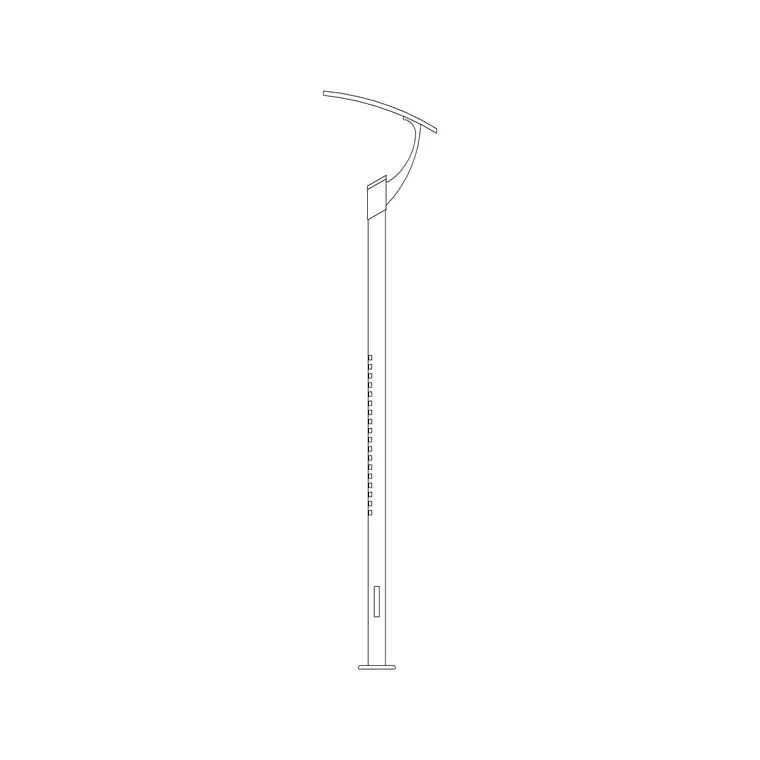
A curved arm street light is the familiar highway lamp post whose bracket sweeps up and out from the top of the column in a gentle curve — the cobra-head or swan-neck profile — carrying the luminaire out over the carriageway. This page offers a free curved arm street light CAD block in DWG and DXF, drawn at true millimetre height so the column and the reach of the curved arm read correctly in a road elevation or site section. It is free for commercial use with no signup or watermark.
The curved arm is functional, not decorative: it carries the light source out over the road so the illumination falls where the traffic is, while the column stays safely at the verge. Showing that reach on the drawing matters, because it tells you how far the luminaire projects toward the carriageway centreline and how the run relates to the kerb. The block captures the column, the curved bracket and the head so the geometry is right for road, car park and access-road drawings.
The cobra-head profile and why it reaches out
On a curved arm street light the bracket leaves the top of the column and curves upward and outward before the head points back down at the road — the shape that gives the cobra-head its name. The reach of that arm sets how far the luminaire sits over the carriageway, which is what lets a verge-mounted column light the middle of the road. That projection is the defining dimension the block needs to show.
The block is drawn as clean geometry on tidy layers so the column, the curved arm and the head stay separate, which helps when you are dimensioning the overhang. It prints sharply at road and site scales like 1:200, 1:100 and 1:50, and being a true block reference, an edit to the definition carries through the whole run.
Column height and arm reach to design around
Use these as ranges and confirm against the road class and the lighting design. A minor or residential road curved-arm light commonly sits in the 5–8 m mounting-height band, while a main carriageway light runs taller, often 8–12 m. The arm reach — how far the head projects horizontally from the column — frequently falls in the 1–3 m range depending on how far over the road the light needs to sit.
These two numbers, height and reach, together place the luminaire over the carriageway. Because the block is full size, you can dimension both straight off the elevation and check that the head sits over the running lane while the column stays clear at the verge or in the central reserve.
Single, opposite and central arrangements
Curved arm lights are arranged to suit the road. A narrow road may be lit from one side, a wider road from both sides in an opposite or staggered run, and a dual carriageway from a central reserve with twin arms or paired single-arm columns back to back. Insert the block, then ARRAY it along the kerb line at the design spacing, mirroring the array for the far side where lights face each other.
Rotate the block so the arm reaches over the correct carriageway, and keep the lights on their own layer so the road geometry and the lighting can be shown independently. For a central-reserve arrangement, place two mirrored blocks back to back so the arms reach both carriageways.
Inserting and orienting the block
The DWG is drawn in millimetres. Insert at scale 1 in a millimetre drawing, 0.001 in a metre drawing, or set INSUNITS to millimetres so an imperial template rescales it. Run INSERT or drag from a palette and pick the insertion point at the base of the column so the pole stands on the kerb or verge line.
Snap the base to the kerb line, then rotate so the curved arm reaches out over the carriageway. ARRAY along the run at the design spacing and MIRROR for opposite-side lighting. Because each light is a block reference, swapping the head type or the column height updates every instance from a single edit, which is exactly what you want on a long road run.
Where curved arm street lights are used
Curved arm lights are the workhorse of road lighting, so they belong in highways and infrastructure drawings: main roads and distributor roads, residential streets, car parks, access roads, industrial estates and roundabouts. They appear in road cross-sections, site layouts, drainage and services coordination drawings and the general arrangement sheets of an infrastructure package.
Drawn at the correct height and reach they set the scale of a road section and show the lighting in context with the carriageway, footway and verge. Free and licence-clear, the block is as useful on a student highways exercise as on a coordinated road and infrastructure set.
Setback, clearance and the swept envelope
Because the curved arm reaches out over the carriageway, two clearances govern where a cobra-head light can stand: the column's setback from the kerb, and the height of the luminaire above the road. The arm has to carry the head out far enough to light the running lane, but the column must sit back from the kerb so it is not struck by a vehicle, and the head must clear the height of the tallest vehicle using the road. Drawing the light full size lets you check all three against the carriageway in section.
On roads with footways or cycle lanes, the column also has to leave a clear walking and riding width past its base, which the plan should confirm. Where a vehicle restraint system is present, the column may need to sit behind it or be of a passively safe type — again, a decision the scaled drawing helps record by showing the pole's true position relative to the kerb and the barrier. Getting the setback and the swept envelope right on the drawing is what keeps a road run both effective and safe.
Free download
Browse the full library — DWG & DXF, no signup.
Questions
Frequently asked
What is a curved arm street light?+
A road lamp post whose bracket curves up and out from the top of the column — the cobra-head or swan-neck profile — carrying the luminaire out over the carriageway while the column stays at the verge.
How far does the curved arm reach?+
The horizontal reach of the arm commonly falls in the 1–3 m range, with column height around 5–8 m for minor roads and 8–12 m for main carriageways. The block is full size, so dimension both off the elevation.
How do I light both sides of a road?+
Insert the block, array it along the kerb at the design spacing, then mirror the array for the far side. For a dual carriageway, place two mirrored blocks back to back in the central reserve so the arms reach both carriageways.
Will it open in older AutoCAD and free viewers?+
Yes. It targets AutoCAD 2004 and later and opens in AutoCAD, AutoCAD LT, BricsCAD, DraftSight and free DWG viewers such as Autodesk's online viewer.
Related downloads
Blocks for this guide
Popular blocks to download
Related categories
Related guides
Block landing
Free Lighting Fixtures CAD Blocks — DWG Download
Download free lighting fixtures CAD blocks in DWG and DXF — chandeliers, wall lights, downlights and pendants in plan and elevation for AutoCAD.
Block landing
Free Table Lamp CAD Blocks — DWG Download
Download free table lamp CAD blocks in DWG and DXF — classical and decorative table lamps in plan and elevation for AutoCAD 2004+. No signup, commercial-use OK.
Block landing
Free Floor Lamp CAD Blocks — DWG Download
Download free floor lamp CAD blocks in DWG and DXF — straight and arc floor lamps in plan and elevation for AutoCAD 2004+. No signup, free for commercial use.