Block landing · ceiling lamp cad block
Free ceiling lamp CAD block in DWG and DXF
By Saumyajit Maity · Published 3 Dec 2024 · Updated 24 May 2026
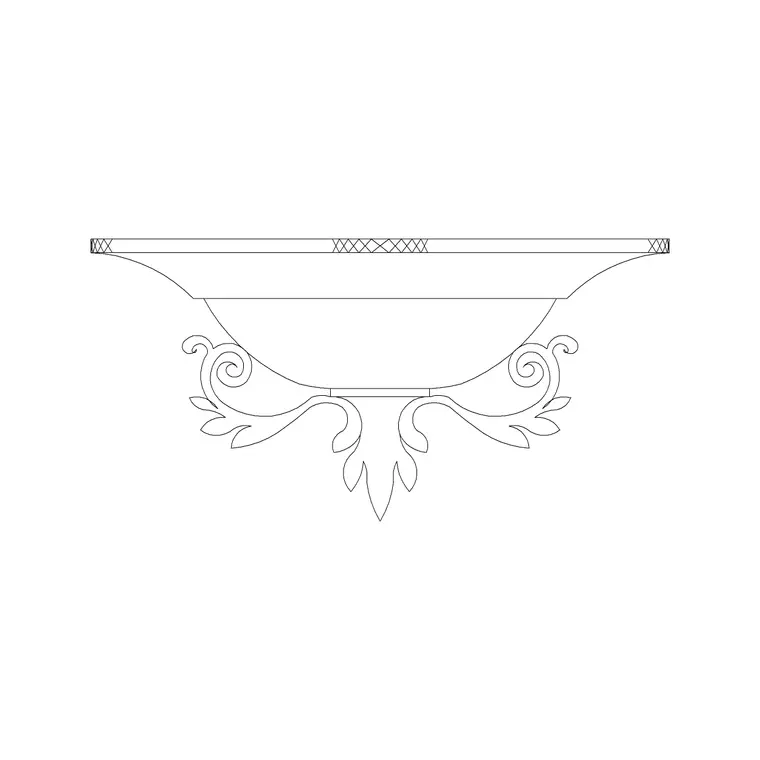
A ceiling lamp is a surface-mounted luminaire that fixes flush or close to the ceiling — the flush and semi-flush fittings that light bedrooms, hallways, kitchens and bathrooms where there is no room or no wish for a hanging pendant. This page offers a free ceiling lamp CAD block in DWG and DXF, drawn at true millimetre size so the fitting sits at the right scale on the ceiling line of an interior elevation or section. It is free for commercial work with no signup, watermark or attribution.
Unlike a pendant, a ceiling lamp barely drops below the soffit, so on a drawing it reads as a compact element hugging the ceiling rather than a fitting hanging into the room. That low profile is exactly why it is used in rooms with lower ceilings, over circulation, and in wet rooms — and it is what the block captures, so the lamp reads correctly against the ceiling line and the head height of the space.
Flush and semi-flush ceiling lamps
Ceiling lamps come in two broad depths, and both matter on the drawing. A flush fitting sits hard against the ceiling with almost no drop, ideal where headroom is tight or a clean ceiling is wanted. A semi-flush fitting hangs a short way below the soffit — typically a modest drop — to throw a little light upward as well as down, giving a softer effect while still staying out of the way.
The block shows the fitting on the ceiling line with its true depth so you can tell at a glance whether it is flush or semi-flush in your elevation. It is drawn as clean geometry on tidy layers, prints sharply at interior scales like 1:50 and 1:20, and as a block reference updates everywhere when you edit it once.
Depth, diameter and ceiling height to design around
Use these ranges and confirm against the chosen fitting. A flush ceiling lamp commonly drops only a small amount below the soffit, while a semi-flush typically hangs in the order of 100–250 mm below it — still well clear of head height. Diameter for a domestic ceiling lamp often falls in the 250–450 mm range, larger for a feature fitting in a hall or living room.
Because a ceiling lamp barely intrudes into the room, it suits ceilings where a pendant would be in the way — and the drawing should show that clearance. With the block drawn full size you can dimension the drop and confirm the fitting clears the head height of the space, which is the reassurance the block exists to give.
Inserting and placing on the ceiling line
The DWG is drawn in millimetres. Insert at scale 1 in a millimetre drawing, 0.001 in a metre drawing, or set INSUNITS to millimetres so an imperial template rescales it. Run INSERT or drag from a palette and pick the insertion point at the centre of the fitting where it meets the ceiling, so it snaps cleanly to the soffit line.
In an interior elevation or section, snap the block to the ceiling line and centre it over the room or the circulation it lights. Keep ceiling lamps on their own lighting layer so they can be shown or hidden independently of the ceiling and joinery. For a row down a corridor, ARRAY the block along the ceiling at the chosen spacing.
Where ceiling lamps are used
Ceiling lamps are the default light in rooms where a pendant would hang too low or simply is not wanted: bedrooms, hallways and landings, kitchens, bathrooms and utility rooms, and any space with a lower ceiling. They also suit circulation in flats, hotels and offices where a flush fitting keeps the ceiling clean and the head height clear.
On a drawing they appear in interior elevations, room sections, and ceiling coordination sheets where the lighting has to agree with extracts, alarms and access panels. The same block crosslinks with the pendant, wall lamp and floor lamp blocks in the lighting category to build a complete lighting layer. Free and licence-clear, it suits student and presentation work as much as a construction set.
Coordinating ceiling lamps with the services layer
Because ceiling lamps sit on the ceiling alongside other services, they belong on a dedicated lighting layer with their own colour, separate from the architecture and from layer 0. That lets you issue a clean ceiling plan or elevation by freezing the lighting, and a services coordination view by thawing it, from the same drawing.
Tag each lamp with a type code as a block attribute and the drawing yields a luminaire count for the lighting schedule and the electrical take-off. In a repetitive building — a hotel floor, a block of flats — a typical room ceiling with its lamp can be WBLOCK-ed as a reusable unit and copied across every identical room, so you are not redrawing the lighting at each one.
Coordinating with the reflected ceiling plan
A ceiling lamp's natural home on a drawing set is the reflected ceiling plan, the view that looks up at the ceiling and shows every fitting, grille, detector and access panel together. Placing the lamp as a full-size block on that plan lets you check it is genuinely centred in the room or the circulation it lights, and that it does not clash with a smoke detector, an extract grille or a sprinkler head sharing the same ceiling.
In rooms with a suspended ceiling the lamp position also has to relate to the grid, so a fitting either centres on a tile or sits on a grid line cleanly rather than awkwardly straddling two tiles. Keeping the ceiling lamps on their own layer lets the reflected ceiling plan read clearly and lets the lamp count drop straight into the fitting schedule. It is this coordination — lamp against detector, grille, sprinkler and grid — that the reflected ceiling plan exists to resolve, and a correctly scaled block is what makes the clashes show up before the ceiling is installed.
Free download
Browse the full library — DWG & DXF, no signup.
Questions
Frequently asked
What is a ceiling lamp in CAD terms?+
A surface-mounted luminaire fixed flush or semi-flush to the ceiling — the compact fittings used where a hanging pendant would be in the way. The block shows it on the ceiling line with its true depth.
How far does a ceiling lamp drop below the ceiling?+
A flush fitting drops only a small amount; a semi-flush typically hangs in the order of 100–250 mm below the soffit, still well clear of head height. The block is full size, so dimension the exact drop off the elevation.
Is the block free for commercial use?+
Yes. It downloads free in DWG and, where available, DXF, with no signup, no watermark and no attribution required, and it is cleared for commercial project work.
Will it open in older AutoCAD or a free viewer?+
Yes. It targets AutoCAD 2004 and later and opens in AutoCAD, AutoCAD LT, BricsCAD, DraftSight and free DWG viewers such as Autodesk's online viewer.
Related downloads
Blocks for this guide
Popular blocks to download
Related categories
Related guides
Block landing
Free Lighting Fixtures CAD Blocks — DWG Download
Download free lighting fixtures CAD blocks in DWG and DXF — chandeliers, wall lights, downlights and pendants in plan and elevation for AutoCAD.
Block landing
Free Table Lamp CAD Blocks — DWG Download
Download free table lamp CAD blocks in DWG and DXF — classical and decorative table lamps in plan and elevation for AutoCAD 2004+. No signup, commercial-use OK.
Block landing
Free Floor Lamp CAD Blocks — DWG Download
Download free floor lamp CAD blocks in DWG and DXF — straight and arc floor lamps in plan and elevation for AutoCAD 2004+. No signup, free for commercial use.