Curated pack · 25 free chandelier cad blocks dwg
Twenty-five free chandelier CAD blocks for AutoCAD in 2026
By Sumana Kumar · Published 5 Aug 2024 · Updated 27 Jan 2026
A chandelier is the one light fitting that has to look right in plan and in elevation, because it is both a reflected-ceiling-plan symbol and a centrepiece a client will picture hanging over a table. This pack brings together 25 free chandelier CAD blocks in DWG — classic crystal tiers, sleek modern rings, branched candelabra and linear pendant bars — drawn to scale for AutoCAD 2004 and later. Every file is free for personal and commercial use, with no signup and no watermark.
Twenty-five styles cover the range you actually specify: the ornate fittings that suit a hotel ballroom or a formal dining room, the minimal ring and globe fittings for contemporary interiors, and the long linear chandeliers that hang over kitchen islands and boardroom tables. You get plan symbols for the reflected ceiling plan and elevation blocks for interior elevations and presentation views.
Because a chandelier is a feature, its size and drop are not afterthoughts — they govern whether the fitting clears head height, balances the room and lines up with the table below. Scaled blocks let you test all of that on the drawing rather than discovering a clash when the fixing point is already cut.
The 25 chandelier styles in the pack
The set is built to cover the main stylistic families. Traditional fittings include multi-arm candelabra and tiered crystal chandeliers with the radiating arm pattern that reads instantly in plan. Modern fittings include single and stacked rings, cascading globe clusters and sputnik-style starbursts. And linear fittings include long bar pendants and rectangular cage frames for islands and tables.
Having the range in one place means a single project can stay coherent — all modern rings, say — or deliberately switch register between a grand entrance and a quiet snug. Each block carries enough detail to read as the intended style in a reflected ceiling plan without becoming a tangle of lines at small scale.
Chandelier sizes and drop to design around
Use these as planning ranges and confirm against the real fitting. Compact chandeliers often sit around 400-600 mm in diameter, mid-size statement fittings around 700-1000 mm, and grand multi-tier or large ring fittings beyond 1000 mm. Linear bar chandeliers are governed by length instead — commonly in the 900-1500 mm range to suit an island or table.
Drop matters as much as diameter. A common rule of thumb keeps the bottom of a dining chandelier well clear of head height while still feeling connected to the table, so check the hanging height against the ceiling and the table surface. Scale the block to the real diameter and your reflected ceiling plan stays honest about how much of the ceiling the fitting fills.
Plan symbol and elevation block
In the reflected ceiling plan you use the plan symbol — the fitting seen from below, showing the arm or ring pattern and overall diameter. This is the block you centre over a table, align with a room axis and coordinate with the ceiling grid, vents and other fittings. Keep it on the ceiling or lighting layer so it sits with the rest of the RCP information.
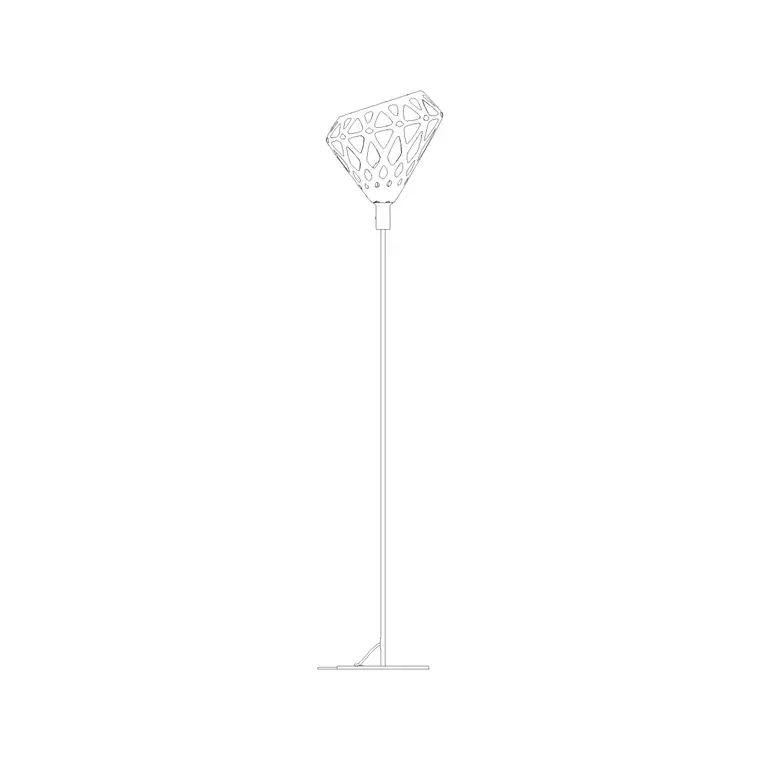
The elevation block shows the chandelier hanging at its drop, with the tiers, arms or globes drawn face-on. Use it in interior elevations and sections to show the fitting in the room, and in presentation views where the chandelier is a focal point. Many of the blocks ship both views so the plan and elevation come from one download.
Centring and coordinating the fitting
A chandelier almost always wants to be centred on something — a dining table, a stair void, a lobby axis — so place it by snapping to a midpoint rather than eyeballing it. Draw the table or room centrelines first, then insert the chandelier at their intersection so it reads as deliberately composed.
The harder part is coordination. A reflected ceiling plan has to reconcile the chandelier with ceiling joints, downlights, sprinklers, smoke detectors and air grilles. Putting the chandelier in at true diameter lets you see whether it crowds a sprinkler head or fights the downlight grid before anyone orders the fitting. If you need to nudge the surrounding services, you can see exactly how much room the chandelier really takes.
Layers, lineweights and reuse
Keep chandeliers on a dedicated lighting or ceiling layer, separate from general furniture, so the reflected ceiling plan can be produced cleanly and the fittings can be frozen when you only want the structural ceiling. A slightly heavier lineweight on feature fittings helps the chandelier read first in a busy RCP.
Because each chandelier is a block reference, swapping styles across a scheme is a matter of redefining or replacing the block, not redrawing. If a project repeats a fitting — the same pendant down a corridor of meeting rooms, for instance — array the block and let one definition drive every instance. Tagging fittings with a type code also lets you extract a simple lighting schedule from the plan.
Where chandelier blocks are used
Chandelier blocks appear wherever a space wants a lighting centrepiece: hotel lobbies and ballrooms, restaurant and dining rooms, residential entrance halls and dining spaces, boardrooms, wedding and event venues, and retail showrooms. They pair with the rest of the lighting category — downlights, wall lights and pendants — to build a complete reflected ceiling plan.
Because the set is free and licence-clear, it is equally useful for student interior schemes, concept presentations and mood boards where a feature fitting sells the idea of a room. Twenty-five styles give you enough range to light a whole building without the same chandelier hanging in every space.
Free download
Browse the full library — DWG & DXF, no signup.
Questions
Frequently asked
Are these 25 chandelier CAD blocks free for commercial projects?+
Yes. All twenty-five download free in DWG with no signup, no watermark and no attribution requirement, and they are cleared for commercial use.
Do the chandelier blocks work in a reflected ceiling plan?+
Yes. The plan symbols show the fitting seen from below with its arm or ring pattern and true diameter, so they sit correctly in an RCP alongside downlights, vents and detectors.
What diameter should I scale a chandelier to?+
Scale to the real fitting. Compact chandeliers often sit around 400-600 mm, mid-size fittings 700-1000 mm, and grand fittings beyond 1000 mm, while linear bars are sized by length. Confirm against the product you are specifying.
Do the files include both plan and elevation views?+
Many do. Where a block ships both, they are in the same DWG so you can use the plan symbol in the RCP and the elevation block in interior elevations and presentation views.
Related downloads
Blocks for this guide
Popular blocks to download
Related categories
Related guides
Curated pack
Free MEP CAD Block Pack — DWG & DXF Download
Free MEP CAD block pack in DWG and DXF — electrical, mechanical and plumbing symbols, fixtures and equipment for AutoCAD services drawings. No signup.
Curated pack
Free Electrical Symbols CAD Block Pack — DWG
Free electrical symbols CAD block pack in DWG and DXF — sockets, switches, light points, data outlets and distribution boards for AutoCAD layouts.
Curated pack
Free HVAC CAD Block Pack — DWG & DXF Download
Free HVAC CAD block pack in DWG and DXF — fan-coil units, AHUs, grilles, diffusers, ductwork fittings and radiators for AutoCAD mechanical drawings. No signup.