Curated pack · free table lamp cad blocks
12 free table lamp CAD blocks for AutoCAD in 2026
By Saumyajit Maity · Published 1 May 2024 · Updated 20 Jun 2026
A table lamp is a small block that does a lot of work in an interior drawing: it dresses a furniture layout, marks where the decorative (rather than architectural) lighting sits, and gives an interior elevation the human-scale detail that makes a room read as lived-in. This collection gathers 12 free table lamp CAD blocks in DWG and DXF: bedside lamps, desk and task lamps, tall console and buffet lamps, classical urn-and-shade lamps, and a few contemporary minimal designs. Everything downloads free for personal and commercial work, with no signup and no watermark.
Unlike a chandelier, a table lamp isn't really a setting-out fixture — it sits on a surface and is part of the decorative layer — but it still earns a scaled block, because in plan it tells the electrician where a socket and a switched supply are wanted, and in elevation it dresses the side table, console or desk at the right height. These blocks ship the plan footprint for the furniture layout and the elevation profile for the interior elevation.
Use the pack across residential and hospitality interiors — bedside tables, study desks, console tables in halls, sideboards and reception desks. The plan blocks dress the furniture plan and flag the socket positions; the elevation blocks dress the interior elevations and presentation views.
What's in the 12-lamp collection
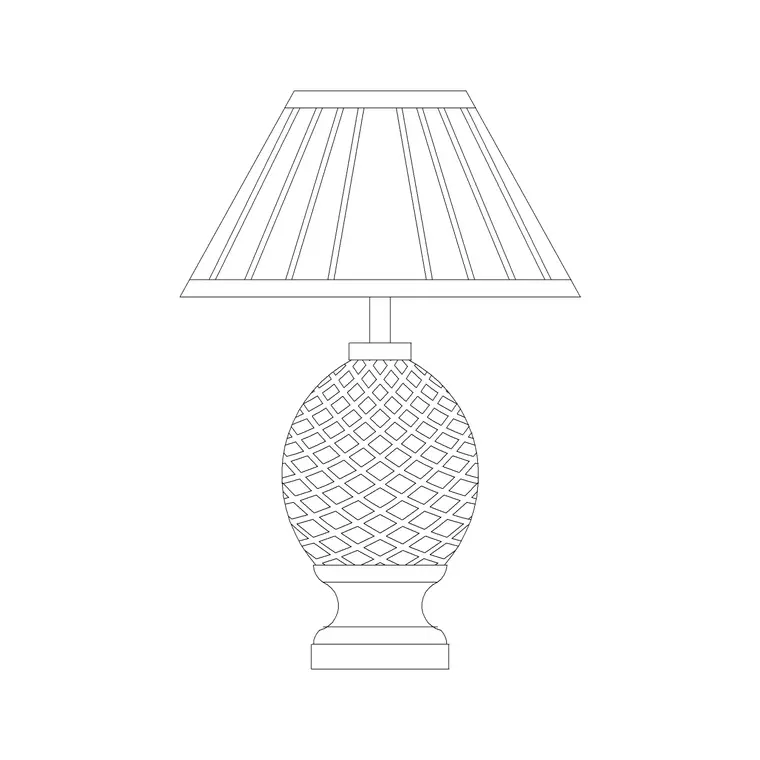
The pack covers the decorative table lamps you place across interiors. Bedside lamps (compact, for nightstands) and reading lamps cover the bedroom; desk and task lamps with an adjustable or angled arm cover the study and office; tall console and buffet lamps suit hall consoles and sideboards where height matters; and classical urn-base lamps with a fabric shade cover period and luxury rooms. A handful of contemporary minimal designs round out the set for modern interiors.
Every block is drawn in plan as the base-and-shade footprint seen from above, and in elevation as the lamp profile at its real height, on a furniture or lighting layer so you can dress the plan, freeze the lamps for a clean layout, or recolour the symbol independently. Because they're decorative items rather than fixed fittings, the blocks are designed to be moved freely around a surface as the layout develops.
Sizing table lamps for the surface they sit on
A table lamp is sized to its surface and its job, and the figures to keep in mind are the overall height and the shade diameter. A bedside lamp is usually fairly compact — often somewhere around 400–550 mm tall — so it lights the nightstand without towering over a seated or lying person. A console or buffet lamp is taller, often 600–800 mm, to read across a hall or above a sideboard. The shade diameter typically runs from roughly 200 mm on a small bedside lamp up to 400 mm or more on a large console lamp.
The practical check is that the lamp suits its table: a tall lamp on a low side table looks top-heavy, and a tiny lamp on a wide console disappears. In elevation, the shade's lower edge ideally sits near eye level for a seated user so the bulb isn't glaring — a useful rule for reading and bedside lamps. Treat these as guidance ranges and confirm against the actual fitting; never lock a layout to an invented exact size.
Plan for the furniture layout, elevation for dressing
In plan, a table lamp dresses the furniture layout and, more usefully, flags where power is wanted. Drop the plan block onto the nightstand, desk or console, and it shows the base-and-shade footprint so you can confirm it doesn't crowd the surface. Just as importantly, its position tells the electrician where a socket and a switched supply belong, so keep the lamps on a layer the electrical layout can reference.
In elevation, the lamp dresses the interior elevation and the presentation view, giving the side table or console its decorative finish at the right height. This is where the lamp's proportion against the furniture reads — a bedside lamp beside a headboard, a pair of console lamps flanking a mirror. Many blocks ship both views, so one download dresses both the furniture plan and the elevation.
Placing lamps in a furniture and lighting scheme
Table lamps belong to the decorative lighting layer — the warm, low-level light that supplements the architectural downlights and the feature chandeliers — so place them once the furniture and the main lighting are set. Put bedside lamps symmetrically on each nightstand, a desk lamp to the non-writing side of a desk so it doesn't cast a hand shadow, and console lamps in a balanced pair on a hall table or sideboard.
With each lamp placed, check there's a socket within reach and that the switched-socket or lamp circuit picks it up — a table lamp with nowhere to plug in is a common coordination miss. Keep the lamps on the furniture or decorative-lighting layer so you can produce a clean architectural plan by freezing them and a fully dressed presentation plan by thawing them, and tag them if you want them to appear on a lighting or FF&E schedule.
Per-item notes: bedside, desk, console and classical
The bedside lamp blocks are the most-placed — keep them compact and symmetrical on each nightstand, with the shade low enough to light a book without glaring at a lying user. The desk and task lamp blocks have an arm or angled head, so orient them to throw light onto the work surface from the side away from the writing hand; the adjustable ones suit studies and home offices.
The console and buffet lamp blocks are the tall statement pieces for halls, sideboards and reception desks — they read across a room, so place them in balanced pairs and check the height suits the furniture beneath. The classical urn-and-shade blocks dress period and luxury interiors and pair naturally with traditional furniture and a crystal chandelier overhead. The contemporary minimal blocks suit modern rooms where a plain base and a simple shade keep the scheme clean. Across all of them, remember the lamp marks a power requirement as much as a decorative choice.
Who uses these table lamp blocks
Interior designers use the table lamp set to dress furniture layouts and interior elevations and to build the decorative-lighting layer that warms a scheme beyond the architectural downlights. Architects use the plan blocks to flag where sockets and switched supplies are wanted so the electrical layout picks them up. Hospitality and residential designers use the console and classical lamps to finish lobbies, bedrooms and feature furniture. Students use them on studio interiors where a dressed side table and a lit console make a presentation read as a real, inhabited room.
Pair the table lamp pack with the chandelier blocks and the broader lighting category to assemble a complete lighting layer — feature fittings, decorative lamps and downlights — from one consistent, free block library, and coordinate it with the furniture so every lamp lands on a real surface near real power.
Free download
Browse the full library — DWG & DXF, no signup.
Questions
Frequently asked
What height is a typical table lamp block?+
Bedside lamps are usually compact, around 400–550 mm tall, while console and buffet lamps run taller at 600–800 mm to read across a hall or sideboard. Treat these as guidance ranges and confirm against the specific fitting.
Why place a table lamp on the plan at all?+
Beyond dressing the furniture layout, a table lamp's position flags where a socket and a switched supply are wanted, so the electrical layout can pick it up. Keep the lamps on a layer the electrical plan references to avoid the classic 'lamp with nowhere to plug in' miss.
Do the table lamp blocks include an elevation view?+
Most do. The plan block dresses the furniture layout and flags power; the elevation block dresses the interior elevation at the lamp's real height, so the proportion against the side table or console reads correctly. Many ship both views in one file.
Are the table lamp CAD blocks free for commercial use?+
Yes. Every lamp downloads free in DWG and, where available, DXF, with no signup, no watermark and no attribution requirement, and they are cleared for commercial project use.
Related downloads
Blocks for this guide
Popular blocks to download
Related categories
Related guides
Curated pack
Free MEP CAD Block Pack — DWG & DXF Download
Free MEP CAD block pack in DWG and DXF — electrical, mechanical and plumbing symbols, fixtures and equipment for AutoCAD services drawings. No signup.
Curated pack
Free Electrical Symbols CAD Block Pack — DWG
Free electrical symbols CAD block pack in DWG and DXF — sockets, switches, light points, data outlets and distribution boards for AutoCAD layouts.
Curated pack
Free HVAC CAD Block Pack — DWG & DXF Download
Free HVAC CAD block pack in DWG and DXF — fan-coil units, AHUs, grilles, diffusers, ductwork fittings and radiators for AutoCAD mechanical drawings. No signup.