Curated pack · free chandelier cad blocks
12 free chandelier CAD blocks for AutoCAD in 2026
By Saumyajit Maity · Published 20 Sep 2025 · Updated 6 Jun 2026
A chandelier is the lighting fixture that does double duty — it lights a room and anchors its ceiling composition — so it shows up on two drawings at once: the reflected ceiling plan that places it, and the interior elevation or section that shows how it hangs. This collection brings together 12 free chandelier CAD blocks in DWG and DXF: classic crystal and candle-style chandeliers, contemporary ring and sputnik designs, tiered (multi-layer) chandeliers, linear suspensions for over dining tables and islands, and simpler pendant clusters. Everything downloads free for personal and commercial work, with no signup and no watermark.
Unlike a chair or a sink, a chandelier's key dimension is vertical — how far it drops below the ceiling — and that drop is what keeps it clear of heads and tabletops. These blocks ship the plan symbol for the ceiling plan and the elevation profile for the section, so you can place the fixture above a table and check its hanging height in the same set of drawings.
Use the pack across residential and hospitality interiors — entrance halls and stairwells, dining rooms over the table, lounges, hotel lobbies and function rooms. The plan blocks go on the reflected ceiling plan and the centring layout; the elevation blocks drive the section and the interior elevation where the drop is set.
What's in the 12-chandelier collection
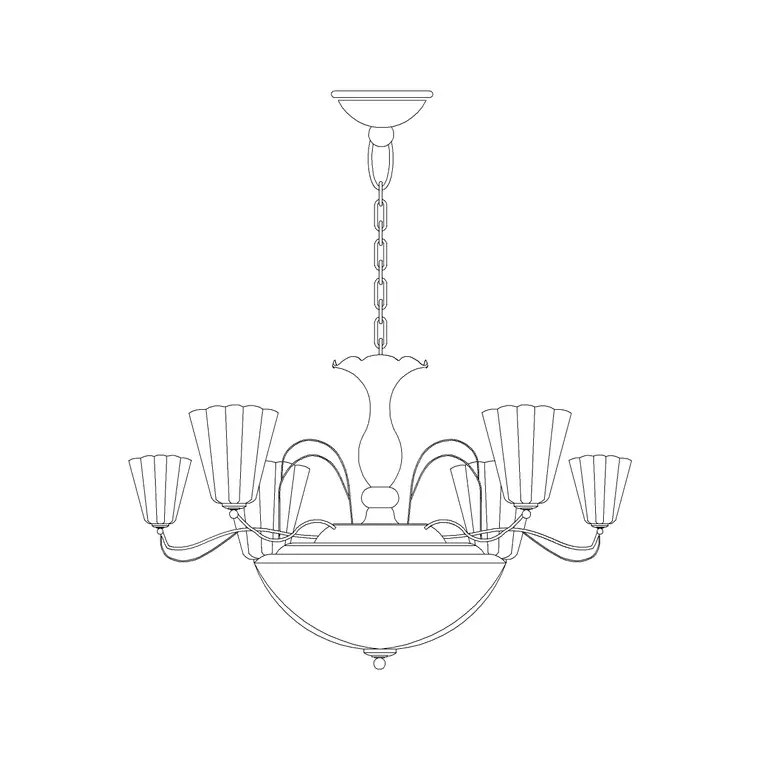
The pack spans the chandelier styles you specify across classic and contemporary interiors. Traditional crystal and candle-style chandeliers cover period and luxury schemes; modern ring (circular) and sputnik (radiating-arm) designs cover contemporary rooms; tiered chandeliers stack two or three layers for double-height halls and stairwells; and linear suspensions stretch a row of lights over a dining table, island or reception desk. A couple of simpler pendant clusters round out the set for casual and transitional spaces.
Every block is drawn in plan as the ceiling symbol — the footprint seen from below, with the arms or ring shown — and in elevation as the hanging profile that carries the drop. The geometry sits on a lighting layer convention so you can place it on the reflected ceiling plan, recolour the symbol, or freeze it independently of the rest of the ceiling.
Sizing and hanging height to design around
A chandelier is sized to the room and the table it serves, and the two numbers that matter are diameter and drop. A rough guide for a room-centre chandelier is to relate its diameter to the room — a larger room carries a wider fitting — while a chandelier over a dining table is usually kept narrower than the table so heads and edges stay clear, often leaving around 150–300 mm of table each side.
The drop is the safety dimension. Over a dining table the bottom of the fixture typically hangs so there is roughly 750–900 mm of clear space above the table surface, which lets diners see across and keeps the fitting out of sightlines. In an open room with people walking beneath, the bottom of the chandelier should clear head height comfortably — well above 2000 mm. The elevation blocks carry the hanging profile so you can set and dimension the drop directly; treat the figures here as guidance and confirm against the specific fitting and the ceiling height.
Plan for the ceiling plan, elevation for the drop
A chandelier lives on the reflected ceiling plan (RCP), which is the ceiling drawn as if mirrored on the floor. Drop the plan block onto the RCP, centre it on the room, the table or the stairwell, and dimension it off the walls or the table centreline so the electrician can set out the ceiling rose. The plan symbol shows the arm or ring footprint so you can check it doesn't clash with other ceiling fittings, beams or the edge of a coffer.
The elevation (or section) is where the drop is set. Switch to the elevation block to show how far the fixture hangs below the ceiling, and dimension that drop against the ceiling height and the table or floor below. This is the view that proves the clearance — over the table, under a beam, within a double-height void — and it is where tiered and linear chandeliers really show their character. Many blocks ship both views so one download serves the RCP and the section.
Centring and coordinating the fixture
A chandelier reads as wrong the instant it is off-centre, so the layout work is mostly about centring. For a dining room, centre the fixture on the table, not the room, because the eye reads it against the table — drop the plan block on the table centreline and dimension it both ways. For an entrance hall or a square room, centre it on the room. For a stairwell, a tiered chandelier is centred in the void and its drop is set so the lowest tier is visible from the upper landing and clears the stair below.
Then coordinate with everything else on the ceiling: downlights, beams, coffers, HVAC diffusers and the structural slab the fixing hangs from. Keep the chandelier on the lighting layer so the RCP, the section and the interior elevation all come from the same block, and tag it with a fixture reference if you want to pull a lighting schedule from the drawing.
Per-item notes: crystal, ring, tiered and linear
The crystal and candle-style blocks are the period and luxury choice — wide footprints with detailed arms, so check the plan symbol against other ceiling fittings and give the elevation drop enough clearance to show the fitting off without dropping into sightlines. The ring and sputnik blocks are the contemporary statements — a circular or radiating footprint that suits a modern room centre; centre them carefully because their geometry makes any offset obvious.
The tiered blocks are built for height: two or three stacked layers for a double-height hall or a stairwell void, where the elevation drop is the whole point — set the lowest tier to read from the upper level and clear the space below. The linear suspension blocks are the table and island specialists: a row of lights stretched along the length, so align the block with the table's long axis and keep it narrower than the table. The simpler pendant clusters are the casual option for transitional and informal rooms where a full chandelier would overdress the space.
Who uses these chandelier blocks
Interior designers and lighting designers use the chandelier set to place feature fittings on the reflected ceiling plan and to set and prove the hanging drop in section. Architects use them to coordinate the fixture with the ceiling structure, the beams and the other services. Hospitality and retail designers use the wider and tiered fittings to anchor lobbies, function rooms and double-height spaces. Students use them on studio interiors where a correctly-centred, correctly-dropped chandelier keeps a scheme convincing.
Pair the chandelier pack with the table lamp blocks and the broader lighting category to build a complete lighting layer — feature fittings, downlights and decorative lamps — from one consistent, free block library, and coordinate it with the furniture layout so every fitting lands where it should.
Free download
Browse the full library — DWG & DXF, no signup.
Questions
Frequently asked
How high should a chandelier hang over a dining table?+
As a guide, hang the fixture so there is roughly 750–900 mm of clear space above the table surface — enough to see across the table and keep the fitting out of sightlines. The elevation blocks carry the hanging profile so you can set and dimension the drop directly.
What drawings do chandelier blocks go on?+
The plan block goes on the reflected ceiling plan (RCP) to place and centre the fixture; the elevation or section block goes on the interior elevation to set the hanging drop and prove the clearance. Many blocks ship both views in one file.
Should a chandelier be centred on the room or the table?+
Over a dining table, centre it on the table, not the room, because the eye reads it against the table. In an entrance hall or a square room, centre it on the room; in a stairwell, centre a tiered fitting in the void.
Are the chandelier CAD blocks free for commercial use?+
Yes. Every chandelier downloads free in DWG and, where available, DXF, with no signup, no watermark and no attribution requirement, and they are cleared for commercial project use.
Related downloads
Blocks for this guide
Popular blocks to download
Related categories
Related guides
Curated pack
Free MEP CAD Block Pack — DWG & DXF Download
Free MEP CAD block pack in DWG and DXF — electrical, mechanical and plumbing symbols, fixtures and equipment for AutoCAD services drawings. No signup.
Curated pack
Free Electrical Symbols CAD Block Pack — DWG
Free electrical symbols CAD block pack in DWG and DXF — sockets, switches, light points, data outlets and distribution boards for AutoCAD layouts.
Curated pack
Free HVAC CAD Block Pack — DWG & DXF Download
Free HVAC CAD block pack in DWG and DXF — fan-coil units, AHUs, grilles, diffusers, ductwork fittings and radiators for AutoCAD mechanical drawings. No signup.