Explainer · open dwg in sketchup
Opening DWG files in SketchUp
By Saumyajit Maity · Published 3 Jun 2026 · Updated 28 Jun 2026
SketchUp does not 'open' a DWG the way AutoCAD does — it imports the geometry. That distinction matters, because what you get is the flat lines and arcs of the drawing brought into SketchUp as edges and faces, which you then trace, push and pull into a 3D model. For architects and designers, importing a 2D DWG plan as a base to build walls on is one of the most common SketchUp workflows there is.
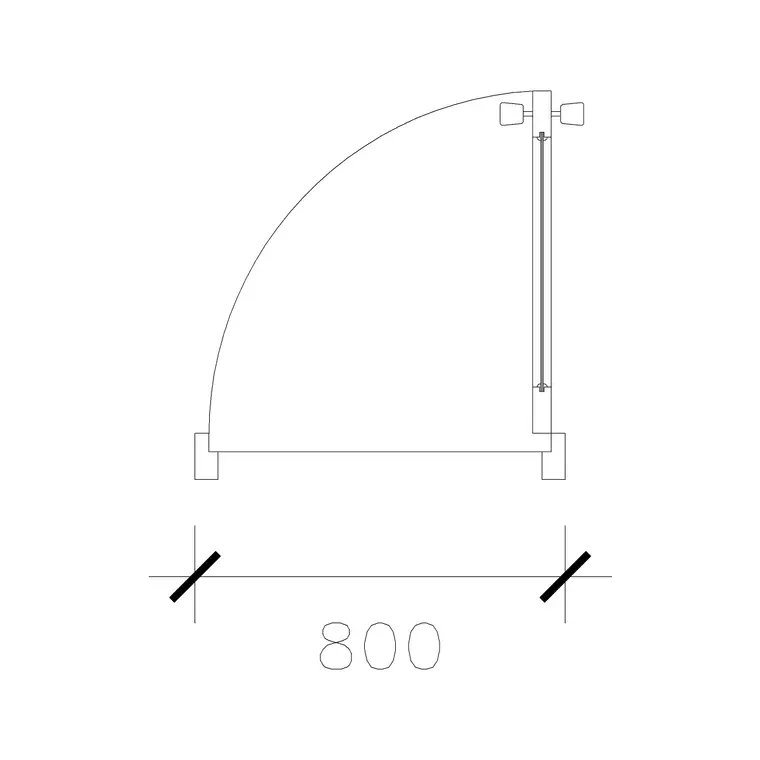
This guide covers whether your version of SketchUp can import DWG, the exact steps, the units mistake that catches everyone, and how to clean up the imported geometry so it models cleanly. The 2D plan and elevation blocks on this site import well as bases and components, because they are drawn cleanly at true scale.
The short version: import the DWG, get the units right, explode and clean the result, and use it as the footprint you build your model on top of.
Which SketchUp versions can import DWG
DWG import is a paid feature. SketchUp Pro (desktop) and the subscription SketchUp Studio import and export DWG/DXF directly. The free web version, SketchUp Free, does not import DWG — it is limited to SketchUp's own formats and image imports. So if 'Import' offers no DWG option, you are almost certainly on the free tier.
If you only have SketchUp Free, you have two routes: convert the DWG to a format SketchUp Free accepts (which loses the precise CAD geometry), or trace over an imported image of the drawing. For real CAD-accurate import you need Pro or Studio. The good news is the import, once available, is straightforward.
Step-by-step: importing a DWG
In SketchUp Pro, go to File > Import, then set the file-type filter to AutoCAD Files (*.dwg, *.dxf). Before you click Import, open the Options button — this is where the units live, and getting them right here saves a lot of pain. Choose the unit the DWG was drawn in (millimetres for the blocks on this site) so the geometry comes in at true size.
Click Import, and SketchUp brings the drawing in as a group of edges (and faces where closed loops exist). Place it at the origin, and you now have a scaled 2D base sitting in your model space, ready to trace and extrude.
The units trap and how to avoid it
The single most common SketchUp import problem is scale: the drawing comes in a thousand times too big or too small, or as a tiny dot in the distance. The cause is almost always a units mismatch between the DWG and the import options. A DWG drawn in millimetres imported as if it were inches lands at the wrong size.
Fix it at the source: in the Import Options dialog, set the units to match what the DWG was actually drawn in. The blocks here are in millimetres, so choose Millimeters. If you forget and the geometry arrives wrong, undo, re-import with the correct units, rather than trying to scale a wildly wrong import by hand — that way you keep true dimensions for accurate modelling.
Cleaning up the imported geometry
CAD geometry is rarely as tidy as SketchUp likes. After import, explode the imported group (right-click > Explode) so the edges become live, then look for problems: tiny gaps where lines don't quite meet (so faces won't form), duplicate edges, and stray geometry on layers you don't need. SketchUp imports CAD layers as 'tags', so you can hide or delete the ones you won't use.
To turn a closed outline into a face, trace one edge of the loop with the Line tool — SketchUp will fill the face if the loop is truly closed. Cleaning the import is where most of the time goes, so import a clean, well-drawn DWG to begin with; the blocks here are drawn closed and to scale specifically to make this stage easier.
From 2D import to 3D model
Once the imported plan is clean and faced, the SketchUp magic begins. Use Push/Pull to extrude walls up from the plan, doors and windows into openings, and furniture footprints into volumes. Keep the imported plan on its own tag so you can hide it once the model stands on its own. A 2D door or window block imported as a base gives you exact opening positions to model against.
This is why importing DWG is so valuable: instead of measuring and redrawing a plan inside SketchUp, you bring the accurate CAD footprint in once and build vertically from it. The result is a 3D model that matches the 2D drawing exactly, with no transcription errors.
Exporting back to DWG
The round trip works the other way too. SketchUp Pro and Studio export to DWG/DXF via File > Export > 2D Graphic (for a flattened view) or 3D model export, so you can take a SketchUp model back into a CAD pipeline. This is handy when a 3D study needs to become a 2D drawing for documentation.
As with import, mind the units on export so the DWG lands at true size in AutoCAD. And remember that SketchUp's geometry is surface-based, so a 3D export produces faces and edges rather than AutoCAD solids — fine for reference and 2D views, less ideal if the recipient expects native CAD solids. For most documentation purposes, the exported DWG is exactly what a drafter needs to trace or annotate.
Free download
Browse the full library — DWG & DXF, no signup.
Questions
Frequently asked
Can SketchUp Free open DWG files?+
No. DWG import is a paid feature available in SketchUp Pro and Studio, not in the free web version. With SketchUp Free you can only trace over an imported image of the drawing, which loses the precise CAD geometry.
Why does my DWG import into SketchUp at the wrong size?+
It is a units mismatch. In File > Import, click Options and set the units to match what the DWG was drawn in — millimetres for the blocks here. Re-import with the correct units rather than scaling a wrong import by hand.
Why won't faces form after I import a DWG?+
Imported CAD edges often have tiny gaps where lines don't quite meet, so SketchUp can't close the loop into a face. Explode the import, find and close the gaps, then trace one edge of the loop to make the face form. Clean, closed source geometry avoids this.
Should I import a plan or an elevation block?+
Import a plan-view block when you want a footprint to extrude walls and rooms up from, and an elevation block when you need accurate heights and opening positions to model against. Many blocks here ship both views so you can import whichever the task needs.
Related downloads
Blocks for this guide
Popular blocks to download
Related categories
Related guides
Explainer
DWG vs DXF: Complete Guide to CAD File Formats in 2026
DWG vs DXF explained — what each CAD format is, how they differ, which to use, file size and compatibility, and how to convert between them in AutoCAD.
Explainer
What Is a DWG File? AutoCAD's Native Format
What is a DWG file? Learn what DWG means, what it stores, how to open one with or without AutoCAD, and why it's the standard format for CAD drawings.
Explainer
What Is a DXF File? The CAD Exchange Format
What is a DXF file? Learn what DXF means, why it exists, what software opens it, and why it's the universal format for laser cutters, CNC and graphics tools.