Explainer · open dwg in illustrator
Opening DWG/DXF files in Illustrator
By Saumyajit Maity · Published 15 Feb 2024 · Updated 26 Apr 2026
Illustrator can bring CAD drawings in, but its support is built around DXF more than DWG — and even then it imports the geometry as vector paths rather than 'opening' a live CAD drawing. That is exactly what you want when the goal is graphics: a site plan turned into a polished diagram, a CAD outline prepared for a laser cutter, or an icon traced from an engineering drawing. The lines and arcs arrive as editable Illustrator paths you can stroke, fill and restyle.
This guide explains the reliable route (usually via DXF), how Illustrator handles scale and units, and the cleanup that turns raw CAD geometry into clean artwork. Many blocks on this site offer a DXF download alongside the DWG precisely so you can take the outline straight into Illustrator or a cutting program.
The practical summary: if you have a choice, import the DXF; if you only have a DWG, convert it to DXF first; then fix the scale, clean the paths, and you have CAD geometry as native vector art.
DWG vs DXF in Illustrator
Illustrator's CAD import has historically centred on DXF, the open, text-based interchange format, rather than DWG, AutoCAD's proprietary binary format. Depending on your Illustrator version, DWG import may be unsupported or unreliable, while DXF import is the documented path. So the dependable workflow is to bring CAD geometry in as DXF.
This is why nearly every block on this site offers a DXF download next to the DWG. If you are heading for Illustrator, Inkscape, a laser cutter or a CNC router, grab the DXF — it is the format the graphics-and-fabrication world reads most readily. If you only have a DWG, the next section covers converting it.
Converting DWG to DXF first
If your file is DWG and you need DXF, the conversion is quick and free. In AutoCAD or any compatible editor (BricsCAD, DraftSight, LibreCAD), open the DWG and use SAVEAS, choosing 'AutoCAD DXF (*.dxf)'. Without any CAD software, the free ODA File Converter from the Open Design Alliance batch-converts DWG to DXF and lets you target a version.
For Illustrator and for laser/CNC work, exporting to an older DXF version such as R12 or 2000 often gives the cleanest result, because it strips out advanced objects that don't translate to simple vector paths. A simpler DXF means fewer surprises when it lands in Illustrator.
Importing the DXF into Illustrator
Open Illustrator and use File > Open (or place the DXF into a document). Illustrator shows a DXF/DWG import options dialog where you set the scale and decide how to map the drawing's units to the artboard. This dialog is where scale problems are won or lost, so pause here rather than clicking straight through.
Choose 'Original Size' if you want to preserve the true dimensions, or 'Scale to fit artboard' / a custom scale if you just need the shapes at a workable size for graphics. Confirm the unit (the blocks here are in millimetres) so the import maps sensibly. After import, the CAD geometry appears as Illustrator paths grouped on layers that mirror the original CAD layers.
The scale and units trap
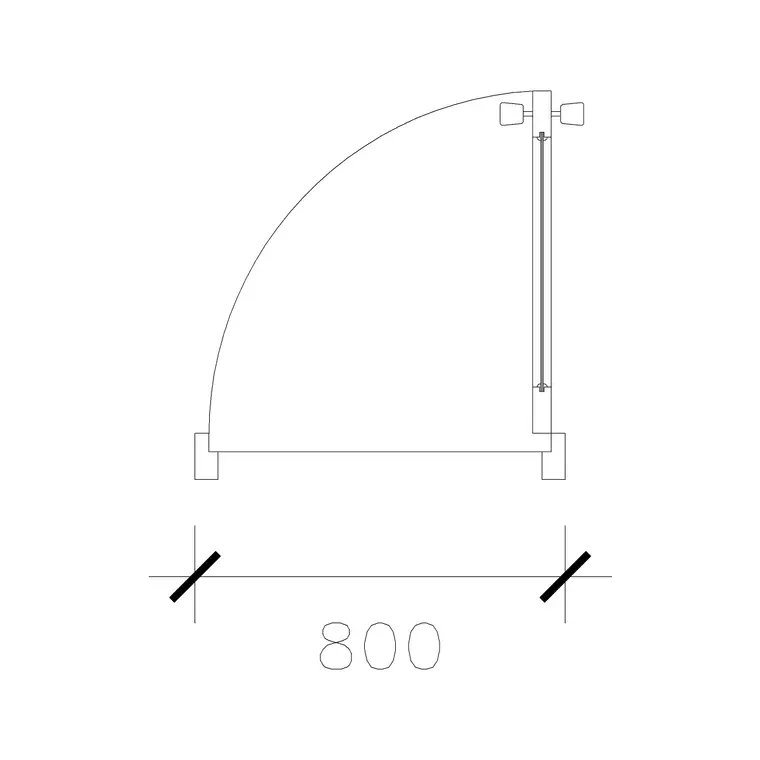
CAD is drawn at full real-world size — a door might be 800 mm wide in the file — while Illustrator thinks in points and artboard dimensions. Without care, a building-sized drawing either explodes far beyond the artboard or shrinks to a dot. The fix is the import-options scale: set it deliberately so the drawing lands at a size you can work with, and keep the proportions locked so nothing distorts.
If you are heading to a laser cutter, scale is not cosmetic — it is the cut size. Import at original size (1:1, millimetres) so the part is physically correct, and verify a known dimension after import (measure the 800 mm door; it should read 800 mm). For pure graphics where only appearance matters, you can scale freely, since you will restyle everything anyway.
Cleaning the paths for graphics or cutting
Raw CAD geometry needs tidying before it looks like artwork. Expect lots of separate path segments, hairline strokes, hatching as dense line groups, and text that may import as outlines or vanish. Select all, set a sensible stroke weight, and use Illustrator's tools — Join, Outline, Pathfinder — to consolidate fragmented paths into clean closed shapes.
For laser cutting, the priority is closed paths with a consistent hairline stroke and no duplicate overlapping lines (which cause the laser to cut the same edge twice). Use Object > Path > Clean Up and check for stray points. For an infographic or a styled diagram, group by layer, apply fills and colours, and delete the CAD layers you don't need. The cleaner the source DXF, the less of this you have to do — another reason to export a simple R12 DXF.
When to use Inkscape instead
If you don't own Illustrator, the free vector editor Inkscape imports DXF and does the same job for graphics and laser cutting. Its DXF import is solid for 2D outlines, and because it is free it is the natural choice for hobbyists and makers preparing parts for a cutter.
The workflow mirrors Illustrator's: import the DXF, set the scale, clean the paths into closed shapes with a hairline stroke, and export. For many laser cutters Inkscape is in fact the standard front end. Whichever vector editor you use, the principle is the same — take the DXF, respect the scale, tidy the paths — and the DXF downloads on this site are made to slot straight into that pipeline.
Free download
Browse the full library — DWG & DXF, no signup.
Questions
Frequently asked
Can Illustrator open a DWG file directly?+
Illustrator's CAD support centres on DXF, and DWG import is unreliable or unsupported depending on the version. The dependable route is to import a DXF — convert your DWG to DXF first if needed. Many blocks here offer a DXF download for exactly this.
How do I convert DWG to DXF for Illustrator?+
Open the DWG in AutoCAD or a free editor like LibreCAD or DraftSight and SAVEAS to 'AutoCAD DXF', or use the free ODA File Converter. Target an older version like R12 or 2000 for the cleanest, simplest vector result.
Why does my CAD drawing import into Illustrator at the wrong size?+
CAD is drawn at full real-world size while Illustrator works in points and artboards, so a units mismatch makes the drawing huge or tiny. Set the scale in Illustrator's DXF import-options dialog, confirm the unit (millimetres here), and verify a known dimension after import.
Is the DXF good for laser cutting from Illustrator?+
Yes. Import the DXF at original 1:1 size so the part is physically correct, then clean the paths into closed shapes with a single hairline stroke and remove duplicate overlapping lines. The DXF downloads here are made to feed straight into a cutting pipeline.
Related downloads
Blocks for this guide

Popular blocks to download
Related categories
Related guides
Explainer
DWG vs DXF: Complete Guide to CAD File Formats in 2026
DWG vs DXF explained — what each CAD format is, how they differ, which to use, file size and compatibility, and how to convert between them in AutoCAD.
Explainer
What Is a DWG File? AutoCAD's Native Format
What is a DWG file? Learn what DWG means, what it stores, how to open one with or without AutoCAD, and why it's the standard format for CAD drawings.
Explainer
What Is a DXF File? The CAD Exchange Format
What is a DXF file? Learn what DXF means, why it exists, what software opens it, and why it's the universal format for laser cutters, CNC and graphics tools.