Explainer · nominal vs actual door size
Nominal vs actual door sizes: what the numbers mean
By Sumana Kumar · Published 17 Mar 2023 · Updated 24 Feb 2026
When a drawing or a supplier calls something a "1000 mm door", that figure is rarely the width of any single physical part. It is a nominal label — a convenient round number that names the door family — and the leaf width, the frame, the structural opening and the clear opening you can actually walk through are all different measurements derived from it. Confusing the nominal size with the actual size is one of the most common sources of dimension errors on a floor plan, and it is worth understanding exactly what each number refers to.
This explainer untangles the four sizes that travel with every door: the nominal size, the leaf (the moving panel), the structural opening (the hole left in the wall), and the clear opening (the unobstructed gap when the door stands open). Knowing which one a number refers to keeps your schedules honest and your CAD blocks correctly placed.
What "nominal size" actually names
A nominal door size is a label, not a tape-measure reading. It groups doors into standard families so that schedules, ironmongery and frames can be specified consistently. A "900 mm" or "1000 mm" door is understood across a project to mean a door from that family, even though no single component measures exactly that figure.
The value usually tracks the leaf width fairly closely, which is why people treat them as interchangeable. But on a tight corridor or an accessible route, the few millimetres of difference between the nominal number and the genuine clear opening can decide whether the door passes a design check. Treat the nominal figure as a name first and a dimension second.
Leaf, frame and structural opening
The leaf is the moving panel — the part on hinges. The frame (or lining) wraps the leaf on the hinge, head and closing sides, so it adds material on each edge. The structural opening, sometimes called the rough opening, is the gap the builder leaves in the wall to receive the frame, and it is deliberately a little larger so the frame can be packed and plumbed.
So for a single door the rough opening is wider than the frame, the frame is wider than the leaf, and the leaf is roughly the nominal size. Each step adds tolerance. When you draw the opening on a plan you are usually showing the structural opening; when you schedule the door you are usually naming the leaf.
Clear opening: the number that matters for access
The clear opening is the unobstructed width measured between the face of the open leaf and the frame stop on the far side — the real gap a person, a wheelchair or a trolley passes through. It is always smaller than the leaf width, because the open leaf itself, the door stop and any projecting ironmongery eat into the gap.
Accessibility checks are written against the clear opening, not the nominal size, which is why a generously labelled door can still fail if the leaf, hinges and stop conspire to narrow the gap. When circulation is tight, calculate the clear opening explicitly rather than trusting the family name on the schedule.
How door sizes appear on a plan
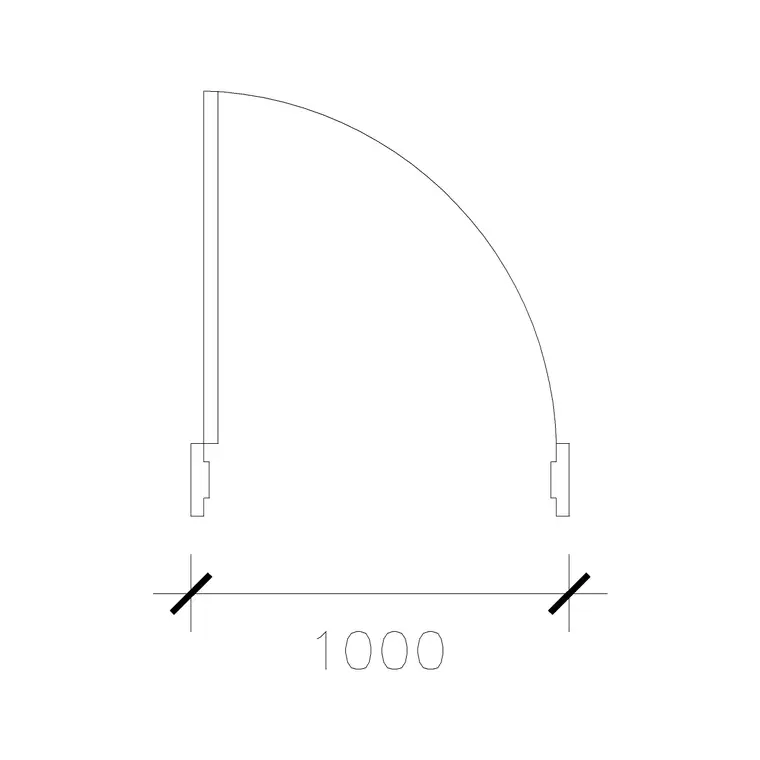
On a floor plan a door is drawn as the structural opening in the wall, the leaf shown open at an angle, and an arc swept by the closing edge to mark the swing. The opening width you dimension is the masonry or stud opening; the door schedule then carries the nominal/leaf size and the handing.
Because a scaled door block already carries a believable opening and swing, dropping one in lets you check the swing clearance against furniture and the adjacent wall at a glance. Keep doors on a dedicated layer so you can isolate them when you produce a door schedule or a fire-strategy drawing.
Typical width ranges to design around
Internal single doors commonly run in a band from roughly the high-700s to about 1000 mm nominal, with the wider end used for accessible routes and main circulation. Bathroom and store doors sit at the narrower end; principal-room and accessible doors at the wider end. Double doors are usually two leaves of a similar family width hung in one opening.
Heights for standard internal doors cluster around the low-2000s in millimetres, with taller leaves used for feature entrances. Treat these as ranges to sense-check a drawing, not as fixed specifications — the controlling figures always come from the project's door schedule and the local building standards in force.
Avoiding the classic sizing mistakes
Three errors recur. First, dimensioning the leaf width on the plan while the builder needs the structural opening — always be explicit about which face the dimension runs to. Second, assuming the nominal size is the clear opening on an accessible route, then losing a check by a handful of millimetres. Third, forgetting that a frame and packing add width, so the hole in the wall must be larger than the door you scheduled.
A reliable habit is to dimension the structural opening on the plan, name the leaf size in the schedule, and verify the clear opening separately wherever access matters. Using a correctly scaled door block keeps all three consistent because the geometry is already drawn to real proportions.
Free download
Browse the full library — DWG & DXF, no signup.
Questions
Frequently asked
Is a 1000 mm door actually 1000 mm wide?+
Not exactly. The 1000 mm figure is a nominal label that usually tracks the leaf width. The structural opening in the wall is wider to take the frame and packing, and the clear opening you walk through is narrower than the leaf. Treat 1000 mm as the door family name, then read the real figures from the schedule.
What is the difference between structural opening and clear opening?+
The structural (rough) opening is the hole left in the wall to receive the frame, so it is the largest figure. The clear opening is the unobstructed gap when the door is open, measured past the leaf and stop, so it is the smallest. Accessibility is checked against the clear opening.
Which door size should I put on a floor plan?+
Dimension the structural opening on the plan, because that is what the builder forms in the wall. Name the nominal or leaf size and the handing in the door schedule. Keep the two consistent so the schedule and the drawn opening describe the same door.
Why does my door fail an accessibility check even though it looks wide?+
Because the check uses the clear opening, not the nominal size. The open leaf, the door stop and any projecting handle reduce the gap below the leaf width. If a route is tight, calculate the clear opening directly rather than trusting the family name.
Do CAD door blocks help me get sizing right?+
Yes. A door block drawn to true millimetre dimensions already shows a believable opening, leaf and swing, so the proportions are correct when you insert it. You still dimension the opening and confirm the clear width, but the geometry starts honest instead of guessed.
Related downloads
Blocks for this guide
Popular blocks to download
Related categories
Related guides
Explainer
DWG vs DXF: Complete Guide to CAD File Formats in 2026
DWG vs DXF explained — what each CAD format is, how they differ, which to use, file size and compatibility, and how to convert between them in AutoCAD.
Explainer
Dynamic Blocks Explained — AutoCAD Guide in 2026
Dynamic blocks explained simply — what they are, how parameters, actions and grips let one AutoCAD block flex into many sizes, and when to use them over plain blocks.
Explainer
Static vs Dynamic Blocks in AutoCAD Compared
Static vs dynamic blocks in AutoCAD — the real difference, the pros and cons of each, when to choose which, and how to convert a static block into a dynamic one.