How-to guide · how to measure total area of placed blocks
Measure the total area covered by placed blocks in AutoCAD
By Sumana Kumar · Published 22 Sep 2025 · Updated 3 Jun 2026
Working out how much floor area a set of blocks occupies sounds simple until you try it — blocks are single references, so AutoCAD will not just hand you the area of a chair the way it gives you the area of a closed polyline. To get the total footprint of placed blocks you combine a couple of techniques: measure one block's area, count the instances, and multiply, or trace a boundary around the group. This matters for space-occupancy checks, furniture coverage and quick takeoffs.
This guide explains why blocks do not report area directly, how to measure a single block's footprint reliably, how to multiply that by an accurate instance count, and how to use AREA and BOUNDARY when you need the actual covered region rather than a sum of footprints.
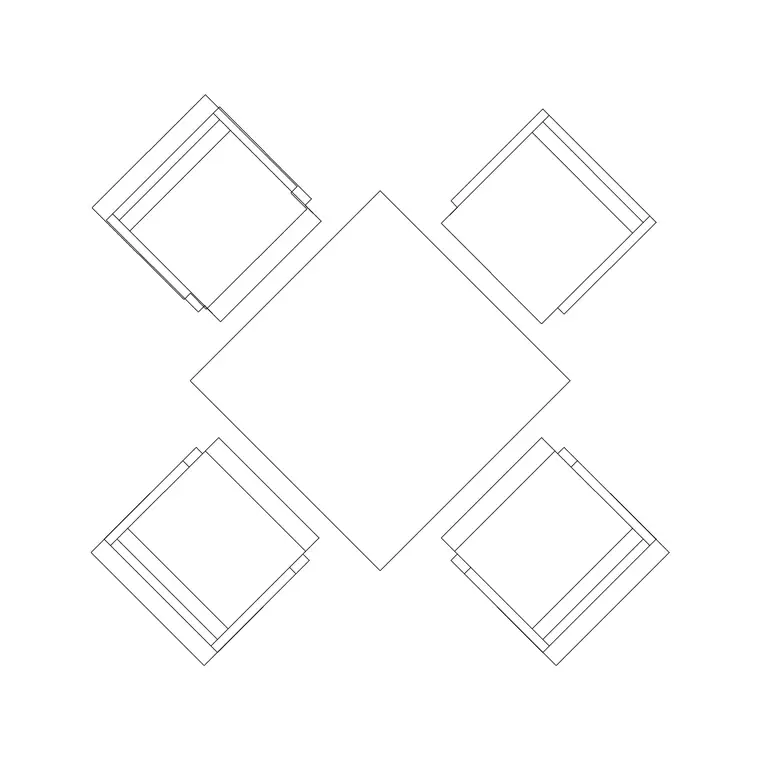
We will use furniture as the main example — totalling the floor area a layout of tables and chairs covers is a textbook reason to do this — with doors as a secondary case for swing-area checks.
Why blocks don't report area directly
A block reference is a single object pointing at a definition, not a closed region, so the AREA command and the Properties palette do not give you a ready area for it the way they do for a closed polyline or hatch. Asking AutoCAD for a block's area returns nothing useful by default — the geometry inside the block is not automatically treated as a measurable region.
That is the hurdle every method below works around. You either measure the footprint by defining a region from the block's outline, or you sidestep per-block measurement entirely and trace the area the blocks cover. Knowing why the direct route fails saves a lot of confused clicking.
Measuring one block's footprint
Open one instance in BEDIT, or explode a copy of the block, and trace its outline with a closed polyline using the BOUNDARY command — click inside the outline and AutoCAD creates a closed polyline following it. Select that polyline and read its Area in the Properties palette.
For a roughly rectangular block like a 4-person table, you can also just multiply its length by its width from the known dimensions. Either way you now have one reliable figure: the footprint of a single instance, which is the building block for the total.
Counting instances accurately
Multiply that single footprint by the number of instances and you have the summed footprint. Get the count with QSELECT (filter Block Reference, Name = your block) or BCOUNT, both of which report an exact instance count for a named block. Using a command rather than counting by eye is what keeps the total honest on a busy plan.
So the formula is straightforward: total footprint = single-block area x instance count. For a mixed layout, do this per block type — tables, then chairs — and add the results. It is simple arithmetic once you have a trustworthy area and a trustworthy count.
Using AREA for the actual covered region
Sometimes you do not want the sum of footprints but the actual floor region the blocks cover, accounting for overlaps and gaps. For that, run the AREA command and pick points around the perimeter of the occupied zone, or use AREA's Object option on a polyline you have drawn around the group.
This gives the gross covered area rather than a per-block sum, which is the right number when blocks overlap or when you care about the zone they collectively sit in — for example the floor a furniture cluster occupies as a whole rather than the literal sum of every leg and seat.
Using BOUNDARY and regions for irregular groups
For an irregular arrangement, BOUNDARY is the cleanest tool: pick an internal point and AutoCAD traces a closed polyline around the bounded region, whose area you then read in Properties. You can also convert outlines to regions with the REGION command and use Boolean union to combine several footprints into one measurable region.
Unioned regions are powerful for overlapping blocks because the union counts shared area only once, giving a true covered area rather than a double-counted sum. It is more setup than the multiply method but it is the accurate answer when footprints genuinely overlap.
A note on door swings and clearances
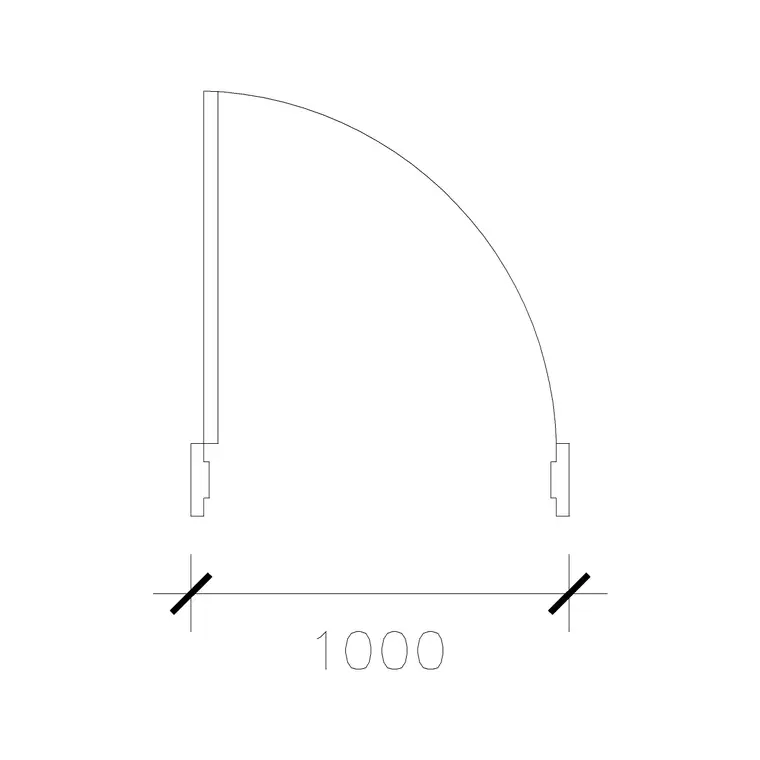
Doors raise a related question: you often want the swing area, not just the leaf footprint. Trace the quarter-circle the door sweeps with BOUNDARY or draw it as a sector, then read its area, to check the floor a door swing sterilises. This is exactly the kind of clearance check a 1000 mm wide single door prompts in a tight plan.
Whatever you are measuring, keep your units in mind: areas come out in the drawing's square units, so a millimetre drawing reports square millimetres. Divide by 1,000,000 to convert to square metres before quoting a furniture-coverage or swing figure to anyone.
Free download
Browse the full library — DWG & DXF, no signup.
Questions
Frequently asked
Why can't AutoCAD give me the area of a block directly?+
A block reference is a single object, not a closed region, so the AREA command and Properties palette do not report an area for it. You have to trace the block's outline into a closed polyline or region first, or measure the area the blocks cover with AREA and BOUNDARY.
What is the quickest way to total the footprint of many identical blocks?+
Measure one block's footprint once (trace it with BOUNDARY and read the polyline's Area, or multiply its length by width), then multiply by an exact instance count from QSELECT or BCOUNT. Total footprint = single-block area x instance count.
How do I measure the actual floor area a furniture cluster covers?+
Use AREA by picking points around the perimeter of the occupied zone, or trace the region with BOUNDARY and read its area. For overlapping blocks, build regions and union them so shared area is counted once, giving a true covered area rather than a double-counted sum.
What units does the area come out in?+
Areas are reported in the drawing's square units. In a millimetre drawing that is square millimetres, so divide by 1,000,000 to convert to square metres before quoting a coverage or door-swing figure.
Related downloads
Blocks for this guide
Popular blocks to download
Related categories
Related guides
How-to guide
How to Insert a DWG Block in BricsCAD
Insert a DWG block in BricsCAD — use the Blocks panel or INSERT command, fix unit scaling, place and rotate, then build a reusable BricsCAD library.
How-to guide
How to Insert a DWG Block in DraftSight
Insert a DWG block in DraftSight — use INSERTBLOCK or Design Resources, set units so it scales right, place it, and save it to a reusable library.
How-to guide
How to Insert a DXF in LibreCAD
Insert a DXF file in LibreCAD — why LibreCAD needs DXF not DWG, how to import or insert a block, fix the millimetre scaling, and place it cleanly on a layer.