How-to guide · how to add a rotation parameter to a block in autocad
How to add a rotation parameter to a dynamic block in AutoCAD
By Saumyajit Maity · Published 16 May 2026 · Updated 10 Jun 2026
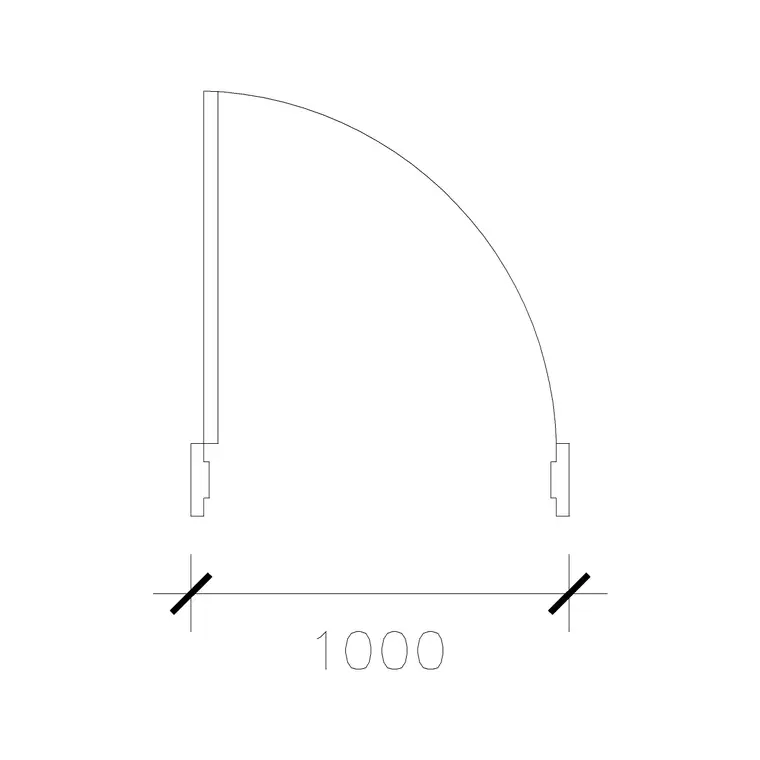
A rotation parameter gives a dynamic block a circular grip that spins geometry about a point — a door leaf that swings to show its open angle, a desk that pivots in a corner workstation, a fitting you orient without leaving the insertion. Where the standard insertion rotation turns the whole block, a Rotation parameter and Rotate action can turn just a chosen part, and can be constrained to sensible angles.
The two things that make a rotation feel right are the base point and the angle limits. The base point is the pivot — for a door it is the hinge — and getting it onto a real piece of geometry is what stops the rotation from looking unhinged. The angle limits keep the grip snapping to useful angles, such as 0, 45 and 90 degrees, instead of any random value.
This guide adds a rotation behaviour step by step, including how to rotate only part of a block, and how to set increment limits so the open-angle reads cleanly on a plan.
Step 1 — Open the block and choose the pivot
Run BEDIT and open the block. Identify the point the geometry should rotate about — the pivot. For a swinging door that is the hinge corner; for a corner desk it is the inside corner. The pivot is the most important decision here, because the Rotation parameter's base point becomes the centre of rotation, and a pivot in the wrong place sends the geometry arcing away from where it should turn.
Use object snaps so you can land the base point exactly on the hinge or corner. A pivot placed by eye, even slightly off, makes a swinging door look like it is floating away from its jamb as it opens.
Step 2 — Add the Rotation parameter
On the Parameters tab, click Rotation. AutoCAD prompts for the base point — snap to the pivot you chose — then for the radius of the parameter (the distance out to the angle grip), then for a default rotation angle. Place the angle grip out where it is easy to grab, beyond the geometry that will swing.
The parameter appears as a small arc with a circular grip. With it selected, open Properties and you can set the base angle and, importantly, the angle type and limits, which we will use in a moment to constrain the swing to useful values.
Step 3 — Add the Rotate action and select geometry
Switch to the Actions tab and click Rotate. Select the Rotation parameter, then select the objects that should turn. For a door, select the leaf and the swing arc but not the frame; for a pivoting desk, select the worktop but not whatever stays fixed. Close the action.
Because the Rotate action only turns the objects in its selection set about the parameter's base point, you can rotate a sub-part of the block while the rest stays still. This is the difference from the simple insertion rotation, which can only turn everything at once.
Step 4 — Constrain the angle to useful values
A free rotation lets the door open to any angle, including 37 degrees, which is rarely what you want on a plan. Select the Rotation parameter and in Properties set the Angle Type to Increment, then enter an angle increment (say 45 or 90) with a minimum and maximum. The grip now clicks only to those angles.
Or set the Angle Type to List and enter a fixed set of allowed angles — useful when a door should only ever show as closed, 45 degrees open, or 90 degrees open. Constrained angles make the drawing read consistently and stop colleagues from leaving doors ajar at odd angles.
Step 5 — Test the rotation
Run BTESTBLOCK and drag the circular grip. The selected geometry should swing about the pivot, and with increments set it should snap to your allowed angles. Confirm the pivot is right: a door leaf should rotate about its hinge, staying attached to the jamb, not orbiting some point in space.
If the geometry rotates about the wrong point, the parameter's base point is off; close the test, move the base point onto the true pivot, and test again. If the frame turns with the leaf, the frame was wrongly included in the Rotate action's selection set.
Pitfalls with rotation parameters
The most common problem is a base point that is not snapped to real geometry, so the rotation pivots around thin air. Always snap the Rotation parameter's base point to the hinge, corner or true pivot. The second issue is including fixed geometry in the action set, which makes the whole block spin instead of just the moving part.
A subtler trap concerns direction: AutoCAD rotates counter-clockwise for positive angles by default, so a door set up to swing the wrong way may need its base angle or limits adjusted, or the leaf drawn on the other side to begin with. Test the swing direction early. Finally, remember that a Rotation parameter is separate from the block's own insertion rotation — the user can still rotate the whole block on insert, and the rotation grip turns the sub-part on top of that.
Free download
Browse the full library — DWG & DXF, no signup.
Questions
Frequently asked
How is a Rotation parameter different from just rotating the block?+
Rotating the whole block on insertion turns everything together. A Rotation parameter with a Rotate action turns only the objects in the action's selection set about a chosen pivot, so you can swing a door leaf while the frame stays fixed.
Why does my geometry rotate around the wrong point?+
The Rotation parameter's base point is not on the intended pivot. Open the parameter, move its base point, and snap it onto the hinge or corner the geometry should turn about.
How do I limit a door to open only to set angles?+
Select the Rotation parameter and set its Angle Type to Increment or List in Properties, with the angles you want — for example 0, 45 and 90 degrees. The grip then snaps only to those values.
Can the whole block still be rotated on insertion?+
Yes. The Rotation parameter adds a sub-part rotation on top of the block's normal insertion rotation, so you can orient the whole block as you place it and still swing the leaf afterwards.
Related downloads
Blocks for this guide
Popular blocks to download
Related categories
Related guides
How-to guide
How to Insert a DWG Block in BricsCAD
Insert a DWG block in BricsCAD — use the Blocks panel or INSERT command, fix unit scaling, place and rotate, then build a reusable BricsCAD library.
How-to guide
How to Insert a DWG Block in DraftSight
Insert a DWG block in DraftSight — use INSERTBLOCK or Design Resources, set units so it scales right, place it, and save it to a reusable library.
How-to guide
How to Insert a DXF in LibreCAD
Insert a DXF file in LibreCAD — why LibreCAD needs DXF not DWG, how to import or insert a block, fix the millimetre scaling, and place it cleanly on a layer.