How-to guide · how to add a flip action to a block in autocad
How to add a flip action to a dynamic block in AutoCAD
By Sumana Kumar · Published 20 Sep 2025 · Updated 25 May 2026
A flip lets one block mirror itself across a line with a single grip click, so you never need separate left-hand and right-hand drawings. It is the natural fix for anything that comes in mirrored pairs — a door that hinges on either side, an asymmetric fitting, a kitchen unit with a hinged door — because the two versions are genuinely reflections of each other rather than different objects.
The behaviour is built from a Flip parameter, which places a reflection line and a small arrow grip, and a Flip action, which binds the geometry to that line. Click the arrow and everything in the action set mirrors across the line; click it again and it returns. Because the flip is just a reflection, scale and proportions are preserved exactly.
This guide builds a flip from scratch and then covers the detail that trips people up — where to put the reflection line, and how to combine a flip with other behaviours so a mirrored door still stretches and sizes correctly.
Step 1 — Open the block and find the mirror line
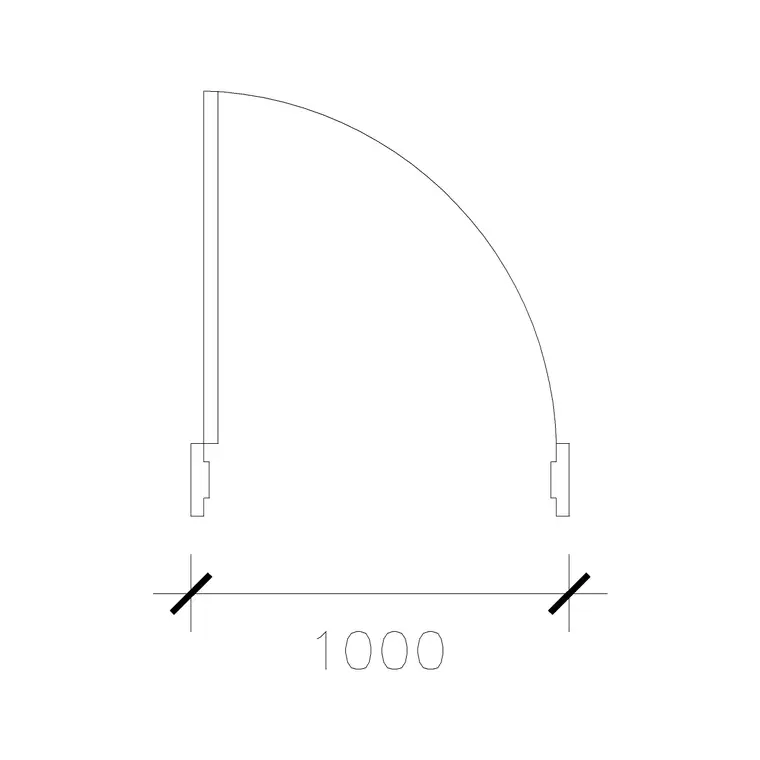
Run BEDIT and open the block you want to make mirror-able. The first real decision is where the reflection line should sit, because everything on the action side of that line swaps to the other side. For a single-leaf door, the natural reflection line runs through the hinge jamb, so the leaf and swing flip from one side of the opening to the other while the frame stays put.
Look at your geometry and identify the axis of symmetry — or, more precisely, the line about which the two desired versions are mirror images. Sketch it mentally before you place the parameter; getting it right first time saves re-doing the action.
Step 2 — Add the Flip parameter and its reflection line
On the Parameters tab, click Flip. AutoCAD asks for the base point of the reflection line and then a second point to set its direction, so click two points along the mirror axis you identified. It then asks for a label location — place the small flip arrow grip somewhere easy to click, usually just outside the geometry near the line.
The reflection line you just drew is the hinge of the whole behaviour. If it is even slightly off the true symmetry axis, the flipped version will land in the wrong place. Use object snaps to anchor both points of the line to real geometry — a jamb endpoint, a midpoint — rather than eyeballing it.
Step 3 — Add the Flip action
Switch to the Actions tab and click Flip. Select the Flip parameter when prompted, then select the objects that should mirror. For a door, that is the leaf and the swing arc, but not the frame, which must stay fixed on both sides. Be deliberate about the selection set: anything you include flips, anything you leave out stays put.
Close the action. A flip action marker appears by the parameter. Unlike a stretch, there is no frame to draw — a flip simply reflects whichever objects you selected across the parameter's line, so the only thing that matters is which objects are in the set.
Step 4 — Test the flip both ways
Run BTESTBLOCK and click the flip arrow grip. The selected geometry should jump to the mirror side of the line, and clicking again should bring it back. Check that the parts you wanted to stay fixed — the door frame, the wall reveal — really did stay put, and that the flipped geometry lands exactly where the opposite-hand version should be.
If the leaf flips but lands in the wrong spot, your reflection line is off the true axis; close the test, move the Flip parameter's line, and try again. If the frame flips along with the leaf, the frame was wrongly included in the action set.
Step 5 — Combine flip with other behaviours
A flip rarely lives alone. A door usually needs both a flip (left-hand or right-hand) and a stretch (to size the opening). When you combine them, add each parameter-and-action pair separately and test them together, because a stretch grip and a flip arrow can interfere if their geometry overlaps. Place the flip arrow clear of the stretch grip so a user does not grab the wrong one.
Order of operations matters during authoring but not for the end user: they can stretch then flip, or flip then stretch, and the block stays correct as long as each action's geometry is defined cleanly. Test the combinations — stretch then flip, flip then stretch — to be sure.
Pitfalls when adding a flip
The classic mistake is including too much in the action set. If you accidentally select the frame, the whole door mirrors and the opening jumps, which looks broken. Select only the parts that genuinely differ between the two hands — usually the leaf and its swing arc.
The second pitfall is a reflection line placed by eye. A few millimetres off the symmetry axis and the flipped door no longer aligns with the jamb. Always snap the Flip parameter's two points to real geometry. Finally, remember a flip is a true mirror: any text inside the flipped set will read backwards. Keep door tags and labels outside the flipped objects, or on a separate attribute that does not mirror.
Free download
Browse the full library — DWG & DXF, no signup.
Questions
Frequently asked
What is the difference between a flip action and the MIRROR command?+
MIRROR creates a permanent reflected copy as separate geometry. A flip action lives inside the block and mirrors the same geometry on demand with a grip, so one block reference can be either hand without making a second object.
Why does my whole door move when I flip it?+
The frame was included in the Flip action's selection set. Re-open the action and select only the leaf and swing arc, leaving the frame out so it stays fixed on both sides.
Can I have more than one flip in a block?+
Yes. Add a second Flip parameter and action with its own reflection line — for example, one to flip left/right and another to flip the swing in/out. Each is an independent pair.
Why does text read backwards after I flip the block?+
A flip is a true mirror, so any text inside the flipped set reverses. Keep labels and tags out of the flip's action set, or carry them as attributes that are not included in the flipped objects.
Related downloads
Blocks for this guide
Popular blocks to download
Related categories
Related guides
How-to guide
How to Insert a DWG Block in BricsCAD
Insert a DWG block in BricsCAD — use the Blocks panel or INSERT command, fix unit scaling, place and rotate, then build a reusable BricsCAD library.
How-to guide
How to Insert a DWG Block in DraftSight
Insert a DWG block in DraftSight — use INSERTBLOCK or Design Resources, set units so it scales right, place it, and save it to a reusable library.
How-to guide
How to Insert a DXF in LibreCAD
Insert a DXF file in LibreCAD — why LibreCAD needs DXF not DWG, how to import or insert a block, fix the millimetre scaling, and place it cleanly on a layer.