Curated pack · us imperial furniture cad blocks
Free US imperial furniture CAD block pack for AutoCAD
By Sumana Kumar · Published 10 Jan 2023 · Updated 31 Mar 2026
Most free CAD block libraries are drawn in millimetres, which makes them awkward to drop into a US drawing set up in feet and inches — they arrive at the wrong size or force a conversion every time. This free US imperial furniture CAD block pack solves that by drawing the everyday furniture you need in imperial units to suit a US architectural template — sofas and sectionals, dining tables and chairs, beds in US mattress sizes, coffee and console tables, desks and casegoods — in DWG and DXF, ready for AutoCAD 2004 or later. All free for personal and commercial work, no signup, no watermark, no attribution.
Use the pack for residential and commercial projects in the United States and anywhere working to imperial conventions. Because the blocks are drawn in inches to suit a US template, they insert at scale 1 into a standard imperial drawing and land at the right size, so you spend your time planning the layout rather than converting units.
The practical win is unit agreement. When the furniture is already in inches, a US plan stays clean: dimensions read in feet and inches, beds match US mattress sizes, and you avoid the classic 'furniture the size of a building' error that comes from inserting metric blocks into an imperial drawing without setting the units.
What's in the US imperial pack
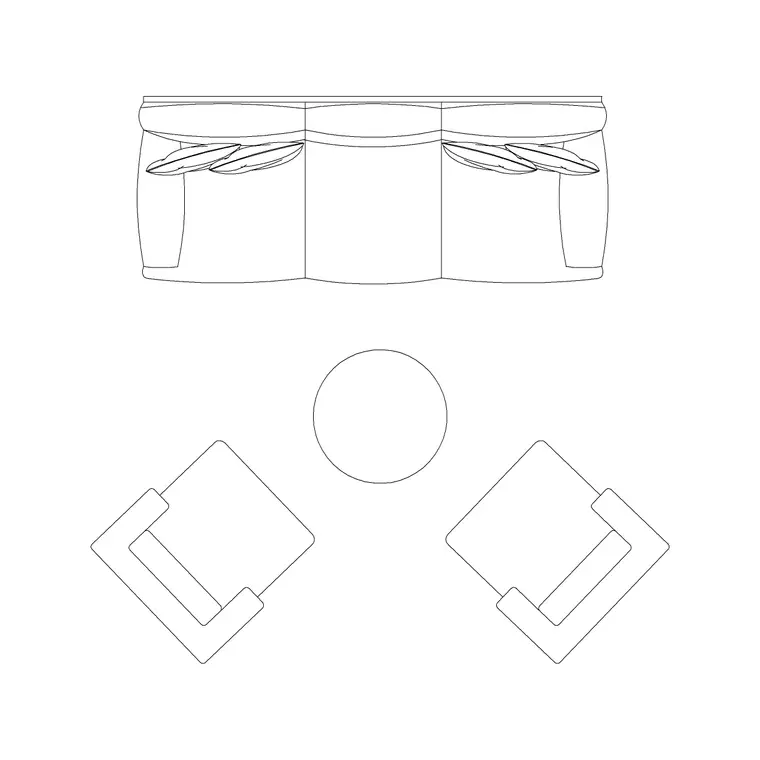
The set spans everyday furniture drawn in imperial units. Living: sofas, loveseats and sectionals, armchairs, recliners and ottomans. Dining: rectangular and round dining tables with chairs and bench options. Sleeping: beds in US mattress sizes (twin, full, queen, king and California king) with nightstands and dressers. Surfaces and storage: coffee and console tables, desks, bookcases and media units.
The defining trait is the unit system, not the styling — these are versatile, broadly contemporary pieces drawn in inches so they belong in a US drawing. Dining tables ship with their chairs so you can place the set as a unit and confirm pull-out room in feet and inches.
Typical US furniture sizes to design around
Use these envelopes as a guide, in imperial units to match a US template. Sofas commonly run around 7 to 8 feet wide (roughly 84 to 96 inches) with a seat height near 18 inches. Dining tables seating six land around 6 feet long by 3 feet wide, at the standard 30-inch height. US bed sizes are fixed: a queen mattress is about 60 by 80 inches and a king about 76 by 80 inches, drawn to those nominal sizes. Coffee tables run roughly 4 feet long at 16 to 18 inches high. Desks commonly sit at a 29 to 30 inch height.
These are common US ranges, not fixed specs — confirm against the actual piece. For circulation, the familiar US rules of thumb apply: allow about 36 inches of clear walkway, around 36 inches behind a dining chair to pull out and stand, and roughly 14 to 18 inches between a sofa and a coffee table.
How to use the set in a US drawing
First confirm your drawing's units. Type UNITS and set the type to Architectural (feet and inches) and the insertion scale to Inches so the blocks land at true size. Because these blocks are drawn in inches, inserting at scale 1 into an imperial template places them correctly; setting INSUNITS to Inches means AutoCAD will rescale automatically if a particular block's units differ.
Then lay out as normal: place the sofa on the main wall, set the dining table with its chairs and confirm the 36-inch pull-out clearance, and drop beds against walls in their US mattress sizes. Use the ARRAY command for repeated pieces and keep furniture on its own layer so you can freeze it for a clean structural plan. Because everything is already imperial, your dimension strings read in feet and inches with no conversion.
Imperial vs metric: getting units right
The single most common problem with free blocks in a US office is a unit mismatch: a millimetre block inserted into an inch drawing arrives about 25 times too small, and an inch block dropped into a millimetre drawing arrives about 25 times too big. This pack is drawn in inches specifically to avoid that on US work.
If you ever do need to mix systems, the fix is INSUNITS, not manual scaling: set the insertion units correctly on both the block and the drawing and AutoCAD rescales on insertion. As a manual fallback, to convert a millimetre block to inches you would insert it at a scale of about 0.03937 (1 ÷ 25.4). But with this imperial pack in a US template, you should be inserting at scale 1 and skipping the arithmetic entirely.
Per-item notes
- Sofa and sectional: place on the main wall; leave 14 to 18 inches to the coffee table for shins. - Dining table and chairs: insert as the set and confirm about 36 inches of pull-out room behind the chairs. - US-size beds: drawn to nominal twin/full/queen/king/Cal-king sizes — pick the size, place against a wall, leave access on at least one long side. - Coffee table: low at 16 to 18 inches — keep it within easy reach of the seating. - Desk: at a 29 to 30 inch height — pair it with an office chair and confirm the chair's pull-back room. - Console table: shallow — use it to dress an entry or sofa-back wall without blocking the 36-inch walkway.
Where the US imperial pack is used
US imperial blocks suit any project working in feet and inches: American residential design and remodels, multifamily and developer schemes, offices and commercial fit-outs, hospitality, and international offices coordinating with US consultants. Combine them with the broader furniture and kitchen categories where you need additional pieces — just keep your insertion units consistent.
Because they are free and licence-clear, they fit concept plans, presentation drawings, competition boards and student briefs where you need credible furniture in imperial units without licensing fuss or unit conversion. The same blocks run from an early concept to a coordinated FF&E set, so the furniture is drawn once, in the right units, and reused throughout the project.
Free download
Browse the full library — DWG & DXF, no signup.
Questions
Frequently asked
What units are these furniture blocks drawn in?+
They are drawn in imperial units (inches) to suit a US architectural template. In a drawing set to Architectural units with the insertion scale set to Inches, they insert at scale 1 and land at true size, so US plans dimension in feet and inches with no conversion.
Do the beds use US mattress sizes?+
Yes. The beds are drawn to nominal US mattress sizes — twin, full, queen, king and California king — so a queen is about 60 by 80 inches and a king about 76 by 80 inches, matching what you'd actually specify on a US project.
What if I'm working in a metric drawing instead?+
Set INSUNITS so AutoCAD rescales on insertion, or insert these inch blocks at a scale of about 25.4 to convert to millimetres. The cleaner route is to keep the drawing and the blocks in the same system — use this imperial pack for imperial drawings and a metric pack for metric ones.
Are these US imperial blocks free for commercial use, and do they open in older AutoCAD?+
Yes on both. Every block is free in DWG and, where available, DXF, with no signup, watermark or attribution, and is cleared for commercial use. The files target AutoCAD 2004 and later, so they open in current AutoCAD, AutoCAD LT, BricsCAD, DraftSight and free DWG viewers like Autodesk's online viewer.
Related downloads
Blocks for this guide
Popular blocks to download
Related categories
Related guides
Curated pack
Free Art Deco Interior CAD Block Pack — DWG
Free Art Deco interior CAD block pack in DWG and DXF — geometric seating, sunburst motifs, mirrored consoles and lounge furniture drawn in plan and elevation.
Curated pack
Free Mid-Century Modern CAD Block Pack — DWG
Free mid-century modern CAD block pack in DWG and DXF — tapered-leg sofas, shell chairs, sideboards and low tables drawn in plan and elevation for AutoCAD.
Curated pack
Free Japandi Interior CAD Block Pack — DWG
Free Japandi interior CAD block pack in DWG and DXF — low platform seating, light-wood tables, floor cushions and minimalist storage in plan and elevation.