Curated pack · japandi cad blocks
Free Japandi interior CAD block pack for AutoCAD
By Sumana Kumar · Published 3 May 2026 · Updated 17 Jun 2026
Japandi blends Japanese restraint with Scandinavian warmth, and the result is low, light, uncluttered furniture with plenty of empty floor between pieces. A layout reads as Japandi when the blocks themselves are low-slung and sparse, so this free Japandi interior CAD block pack gathers the right vocabulary — low platform sofas and beds, floor cushions, light-wood slatted benches, minimal sideboards, paper-shade floor lamps and simple round tables — in DWG and DXF at true millimetre dimensions, ready for AutoCAD 2004 or later. All free for personal and commercial use, no signup, no watermark, no attribution.
Use the pack for calm residential schemes, wellness and spa interiors, boutique studios, tea rooms and any project chasing a quiet, grounded mood. The blocks are scaled, so the generous negative space that defines the style — the deliberate emptiness around each piece — is something you can plan precisely rather than leave to chance.
Japandi is the rare style where what you leave out matters more than what you put in. That makes honest footprints and protected clearances essential: the calm only reads if the gaps are real, not cramped.
What's in the Japandi pack
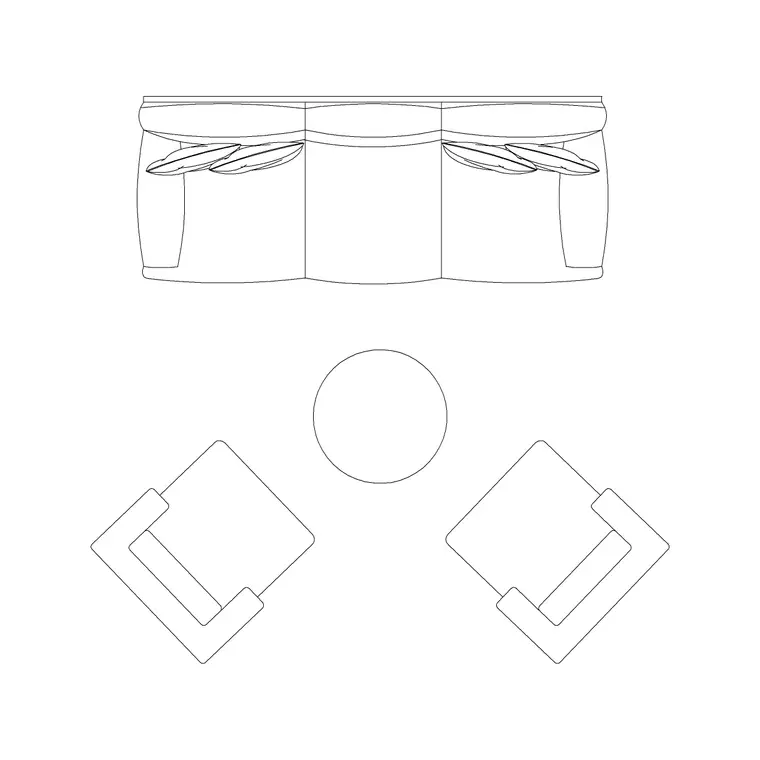
The set covers low, natural-material pieces. Seating: low-arm platform sofas, floor cushions and zabuton, slatted benches and a single sculptural lounge chair. Tables: low round and oval coffee tables, a light-wood dining table with bench seating, and small side stools. Storage and sleep: low platform beds, slim minimalist sideboards and open shelving units. Soft and decorative: tatami-proportioned rugs, paper-shade floor and table lamps, and a few ceramic vessel symbols.
The unifying trait is lowness and lightness — everything sits close to the floor and reads as slim in plan. Dining tables ship with their matching benches in the same file so you can place the eating set as a unit.
Typical Japandi sizes to design around
Use these envelopes as a guide. A low platform sofa runs roughly 1800–2100 mm wide with a notably low seat height around 350–400 mm. Floor cushions are commonly 600–700 mm square. Coffee tables are very low at 300–380 mm high and 900–1200 mm across. A light-wood dining table lands around 1600–2000 mm long with bench seating rather than chairs. Platform beds keep a low 250–350 mm mattress-top height.
These are typical-of-the-style ranges, not fixed specs — confirm against the actual piece. For circulation, Japandi wants air: leave 1000 mm or more of clear floor around a seating group, because the empty space is part of the design, not wasted area.
How to compose a Japandi room from the set
Begin by deciding how much floor to leave empty, then place the smallest number of pieces that make the room work. Set a low sofa or bench against one wall, float a low round table just off it, and use floor cushions rather than extra chairs to keep the sight lines low. Resist filling the perimeter — Japandi reads through restraint, so an under-furnished plan is usually the correct plan.
Keep everything on a consistent low datum so the eye travels uninterrupted across the room. A single tall element — a floor lamp or a slim shelving unit — provides the vertical accent against all that low horizontal furniture. Put rugs, lamps and ceramics on their own layer; freezing them gives you a stripped technical plan, thawing them gives you the dressed scheme.
Plan and elevation views
In plan you place the slim, low footprints and, crucially, measure the empty floor between them — the negative space is the design. In elevation you show how low the furniture sits, the light-wood slatting and the single tall accent, which is where Japandi distinguishes itself from generic minimalism. Several blocks carry both views in one DWG.
Elevation heights are the Japandi signature: very low seating, low tables, low beds, and a long uninterrupted horizontal line broken by one vertical element. The elevation blocks are drawn to that low datum so the side view holds the calm proportion.
Per-item notes
- Platform sofa: low-arm or arm-less — keep the surrounding floor clear so its lowness reads. - Floor cushions: use these instead of extra chairs; they keep sight lines low and add flexible seating. - Low round table: float it, don't push it against the sofa; the gap is intentional. - Light-wood dining set: table and benches insert together; benches tuck fully under to keep the footprint compact. - Slim shelving: the one acceptable tall element — use it sparingly as the vertical accent. - Paper floor lamp: drawn light in plan; on the lighting layer so you can dim it down for technical plots.
Where the Japandi pack is used
Japandi blocks suit calm residential and wellness work: minimalist apartments, spa and wellness suites, yoga and meditation studios, tea rooms, boutique hotels and quiet retail. Combine them with the broader furniture and lighting categories where you need additional low, neutral pieces.
Because the files are free and licence-clear, they fit concept plans, mood boards, competition entries and student interior briefs where you need credible minimalist furniture without licensing fuss. The same blocks run from an early concept through to a coordinated FF&E drawing, so the calm layout is drawn once and reused.
Free download
Browse the full library — DWG & DXF, no signup.
Questions
Frequently asked
How is Japandi different from plain minimalism in CAD terms?+
Japandi blocks are specifically low and natural-material, with low platform seating, floor cushions and light-wood tables, and they are meant to be placed sparsely with large clear gaps. Generic minimalist furniture can sit at normal heights; these are drawn to a deliberately low datum so the side view reads Japandi.
Are the Japandi blocks free to use commercially?+
Yes. Every block is free in DWG and, where available, DXF, with no signup, watermark or attribution, and is cleared for commercial residential and hospitality projects.
Why is so much of a Japandi plan left empty?+
Negative space is the style. The calm reads only when there is generous clear floor — typically 1000 mm or more — around each piece, so an under-furnished plan is intentional rather than incomplete.
Will these open in older AutoCAD or free viewers?+
Yes. The DWG files target AutoCAD 2004 and later and open in current AutoCAD, AutoCAD LT, BricsCAD, DraftSight and free DWG viewers such as Autodesk's online viewer.
Related downloads
Blocks for this guide
Popular blocks to download
Related categories
Related guides
Curated pack
Free Art Deco Interior CAD Block Pack — DWG
Free Art Deco interior CAD block pack in DWG and DXF — geometric seating, sunburst motifs, mirrored consoles and lounge furniture drawn in plan and elevation.
Curated pack
Free Mid-Century Modern CAD Block Pack — DWG
Free mid-century modern CAD block pack in DWG and DXF — tapered-leg sofas, shell chairs, sideboards and low tables drawn in plan and elevation for AutoCAD.
Curated pack
Free Bohemian Interior CAD Block Pack — DWG
Free bohemian interior CAD block pack in DWG and DXF — rattan seating, poufs, layered rugs, plants and low tables for relaxed boho layouts in AutoCAD.