Curated pack · free wardrobe cad blocks
12 free wardrobe CAD blocks for AutoCAD in 2026
By Sumana Kumar · Published 1 Mar 2025 · Updated 10 Mar 2026
Wardrobes are bulky, fixed pieces that shape a bedroom's whole circulation, so getting them in at the right size early keeps a layout honest. This pack gathers 12 free wardrobe CAD blocks in DWG and DXF — hinged double and triple wardrobes, multi-door runs, sliding-door units and walk-in arrangements — each drawn at true millimetre dimensions and ready to insert into AutoCAD 2004 or later. Everything is free for personal and commercial work, with no signup and no watermark.
A wardrobe is both a plan and an elevation block. In plan you set out its footprint against a wall and, crucially, check the swing of any hinged doors into the room. In elevation you draw the door faces and the internal shelving for joinery and presentation drawings. Because the blocks are scaled, the door-swing clearance — the thing that most often catches out a bedroom layout — is visible from the moment you place the unit.
The round-up spans from a compact two-door wardrobe up to wide six and seven-door runs, so whether you are fitting a box room or specifying a full dressing wall you have a scaled starting point.
What the 12-wardrobe pack covers
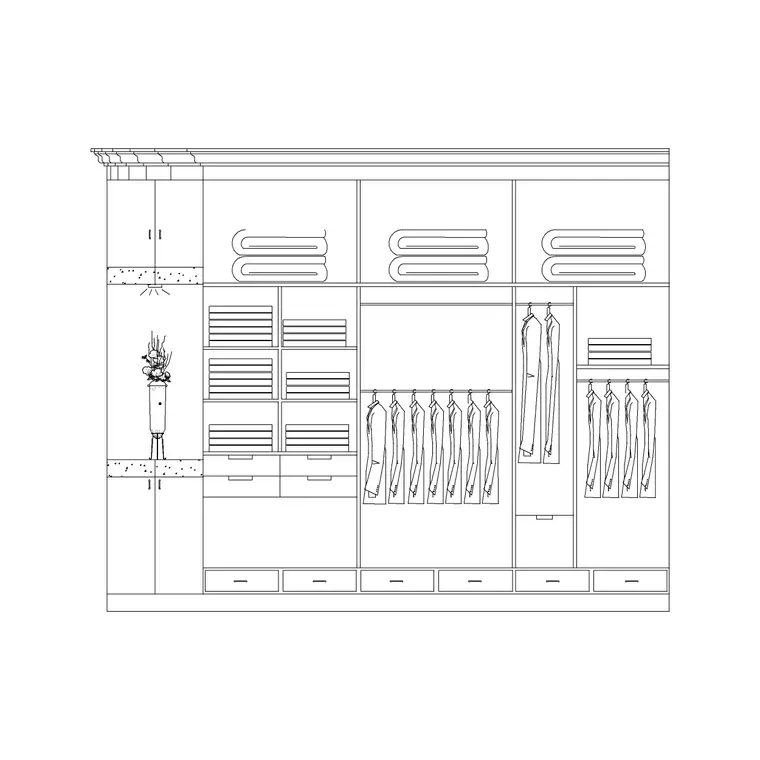
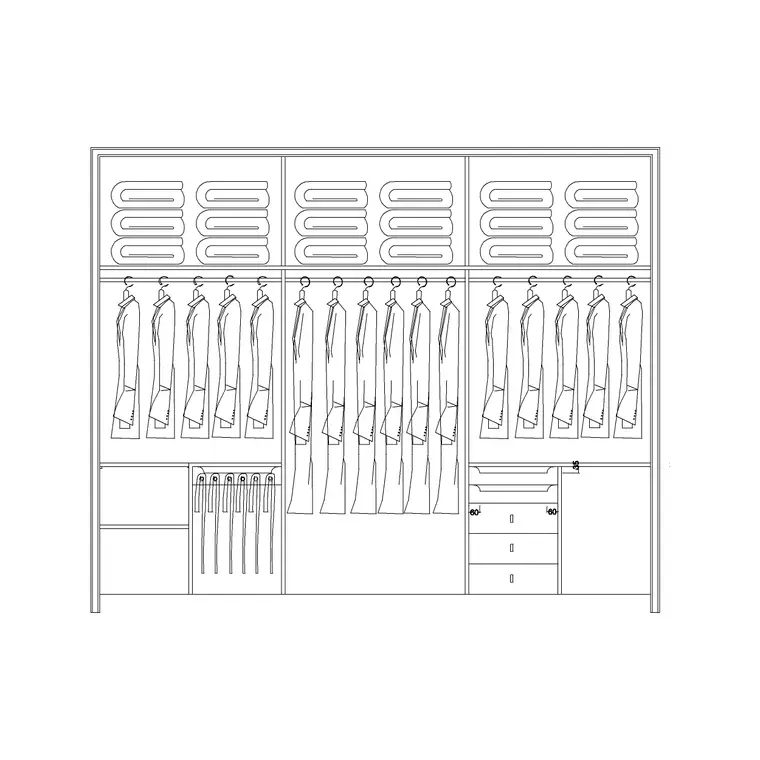
The selection runs the gamut of bedroom storage. Compact two-door hinged wardrobes suit single and small rooms. Three and four-door runs are the standard for a double bedroom. Wide six and seven-door wardrobes — like the multi-door units in this pack — span a full wall and suit master bedrooms and dressing areas. Sliding-door wardrobes are included for tight rooms where hinged doors would foul the circulation.
Most blocks carry a plan footprint with the door positions indicated, and several add an elevation of the door faces. Where doors are hinged, the plan shows the swing arc so you can confirm it clears the bed, the walkway and any adjacent furniture.
Hinged vs sliding: the door-swing decision
The choice between hinged and sliding doors is usually a clearance decision, and it is one the blocks make easy to test. A hinged wardrobe door swings out roughly the width of the door — commonly 400-500 mm — so you need that arc of clear floor in front of every door. In a tight room those arcs quickly clash with the bed or block the walkway.
Sliding doors need no swing space, which is why they win in narrow rooms, but they only ever open half the wardrobe at once. Place the hinged-door blocks first and check the swing arcs against the room; where they foul the layout, swap in a sliding-door block of the same width and the clearance problem disappears.
Typical wardrobe dimensions to design around
Design around these figures. A standard wardrobe is around 580-600 mm deep — enough to hang clothes on a front-to-back rail. Per hinged door, allow about 450-600 mm of width, so a two-door unit is roughly 900-1200 mm wide, a four-door run 1800-2400 mm, and a six-door run 2700-3600 mm. Standard wardrobe height runs 2000-2400 mm, often to a separate top-box at ceiling level.
In front of a hinged wardrobe, keep at least 600-750 mm of clear floor so a person can stand and access the full depth of the unit, more where the doors swing. These ranges let you size a wardrobe to the wall it sits on and confirm it does not choke the room.
Placing a wardrobe in a bedroom plan
Set the wardrobe against the longest uninterrupted wall, clear of windows and ideally near the door so it does not dominate the sleeping zone. Insert the block, snap its back to the wall, and rotate it to face into the room. For hinged units, immediately check the door-swing arcs against the bed, the bedside tables and the walkway.
Keep the wardrobe on a furniture or joinery layer so you can produce a clean room plan and a separate joinery elevation from the same drawing. For a built-in or fitted run, you can stretch a modular wardrobe block along the wall, or array door modules to fill the available length exactly.
Plan for layout, elevation for joinery
Use the plan view to set out the wardrobe and prove the circulation: footprint against the wall, door swings checked, walkway clear. That is the drawing that decides whether the storage fits the room. For a fitted-wardrobe project, the plan also coordinates the unit with skirtings, sockets and any returns.
Use the elevation for the joinery and presentation set: the door faces, handle positions, the internal hanging rails and shelves, and the top-box line. The elevation blocks here let you show a client what the wardrobe wall will look like, and give a joiner the face dimensions to build to, all drawn from the same scaled units as the plan.
Where wardrobe blocks are used
Wardrobes appear in residential bedroom plans, hotel rooms, student accommodation, serviced apartments and any space with hanging storage. Architects use them to prove a bedroom layout works; interior and joinery designers use them to specify fitted storage runs and produce the elevations a joiner builds from.
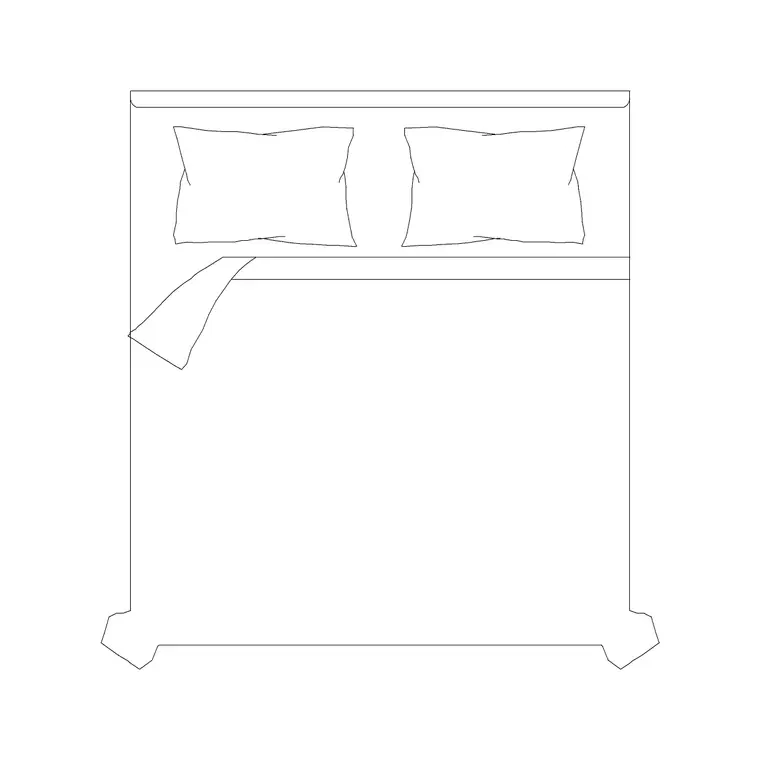
Pair the wardrobe pack with the bed, bedside-table and dressing-table blocks in this furniture round-up series to lay out a complete bedroom from one consistent, free library. Drawn to standard sizes and licence-clear, the same wardrobe carries from a concept layout through to a coordinated joinery drawing.
Free download
Browse the full library — DWG & DXF, no signup.
Questions
Frequently asked
Do the wardrobe blocks show the door swing?+
The hinged-door wardrobe blocks indicate the door swing arc in plan, so you can check it clears the bed, bedside tables and the walkway. Sliding-door units need no swing space and are included for tight rooms.
How deep is a standard wardrobe block?+
Around 580-600 mm, which is the depth needed to hang clothes on a front-to-back rail. Width depends on the door count — roughly 450-600 mm per door — and height is typically 2000-2400 mm.
Do the wardrobes come in plan and elevation?+
Most carry a plan footprint for layout, and several add an elevation of the door faces and internal shelving for joinery and presentation drawings. The views are listed on each block's download page.
Are the wardrobe CAD blocks free for commercial use?+
Yes. Every block downloads free in DWG and DXF with no signup, no watermark and no attribution requirement, and they are cleared for commercial project use.
Related downloads
Blocks for this guide
Related categories
Related guides
Curated pack
Free Bedroom CAD Block Pack — DWG & DXF
Free bedroom CAD block pack in DWG and DXF — double beds, side tables, wardrobes and seating in plan and side view for AutoCAD. No signup, commercial OK.
Curated pack
Free Living Room CAD Block Pack — DWG & DXF
Free living room CAD block pack in DWG and DXF — sofa sets, coffee tables, rugs and seating in plan for AutoCAD lounge layouts. No signup, commercial OK.
Curated pack
Free Wardrobe & Closet CAD Block Pack — DWG
Free wardrobe & closet CAD block pack in DWG and DXF — fitted, sliding and walk-in wardrobes in plan for AutoCAD bedrooms. No signup, commercial OK.