Curated pack · free bed cad blocks
12 free bed CAD blocks for AutoCAD in 2026
By Sumana Kumar · Published 13 May 2024 · Updated 17 May 2026
The bed is the fixed point a bedroom is designed around — everything else negotiates the space it leaves — so a set of correctly-sized bed blocks is the natural starting point for any bedroom layout. This round-up gathers 12 free bed CAD blocks in DWG and DXF: single, double, queen and king beds, with and without bedside tables, drawn at true millimetre dimensions and ready to insert into AutoCAD 2004 or later. Everything is free for personal and commercial work, with no signup and no watermark.
Beds are a plan-view block. You place the bed, then check the access strips down each side and at the foot, the door swing, and the clearance to wardrobes and other furniture. Because the blocks are scaled to standard mattress sizes, those circulation checks are immediate — and a bed drawn at the right size is what tells you whether a room is genuinely a double or only a generous single.
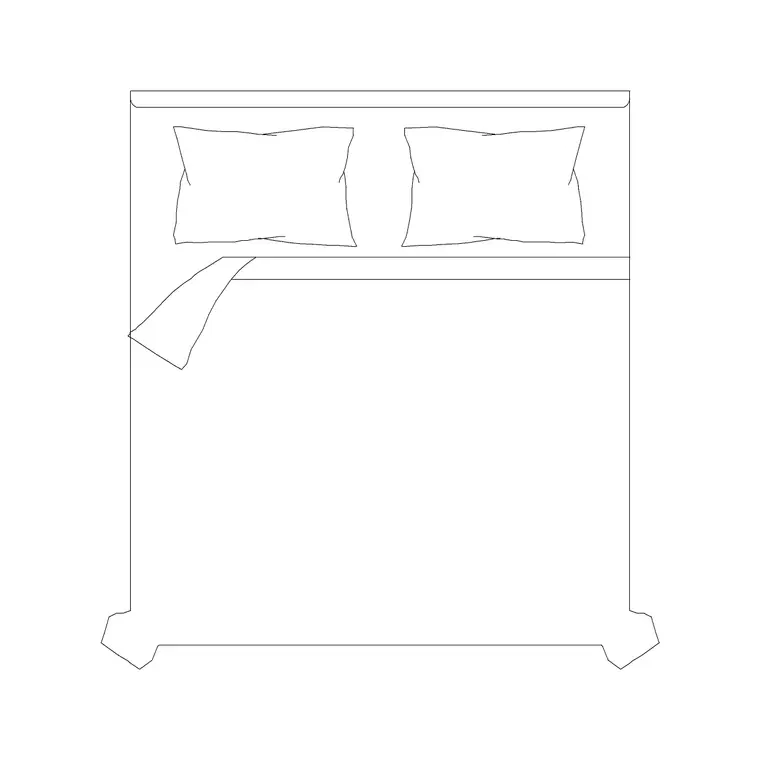
The pack ranges from a 900-wide single up to a king, including a double bed drawn without side tables so you can add your own bedside blocks to suit the room.
What's in the 12-bed round-up
The selection covers the standard mattress sizes and a few useful variants. Single beds suit children's rooms, guest rooms and student accommodation. Double and queen beds are the staple of most bedrooms. King and super-king beds anchor master suites. Some blocks include integrated bedside tables for a quick, complete arrangement; others — like the double bed drawn without side tables here — give you a clean bed footprint to combine with your own bedside blocks.
Each bed is drawn from above with the headboard, mattress outline and often the pillows and a turned-back cover indicated, so the plan reads clearly as a bed and orients correctly against the head wall.
Standard mattress and bed sizes
Bed sizes are largely standardised, which is what makes scaled blocks so reliable. As a guide, a single mattress is around 900 x 1900 mm, a small double around 1200 x 1900 mm, a standard double around 1350-1400 x 1900 mm, a queen around 1500 x 2000 mm, and a king around 1800 x 2000 mm. The bed frame and headboard add roughly 50-150 mm around the mattress, so the block footprint is a little larger than the mattress figure.
Note that exact sizes vary by region — UK, US and European standards differ — so always confirm against the local standard for a real project. The double bed in this round-up, for instance, is drawn at an 1800 x 2000 mm footprint, a generous king-scale double.
The clearances a bedroom needs
Around a bed, a few access strips decide whether the room works. Allow at least 600-750 mm of clear floor down each side that is used for getting in and out, and the same at the foot if there is a walkway there. Where a side is against a wall, you can drop the clearance, but then only one person can access that side. In front of a wardrobe near the bed, keep the door-swing space clear of the mattress.
Draw the bed block, then offset these strips and you can see at once whether a layout that looks fine as a rough box actually leaves room to walk, open drawers and make the bed. This is precisely the check that an unscaled placeholder hides.
Setting out a bedroom from the bed
Place the bed first, head to the longest solid wall, clear of the window and ideally not directly in line with a swinging door. Insert the bed block and snap the headboard to the wall. Then add bedside tables to the free sides, a wardrobe to a clear wall (checking its door swing), and a dressing table or chest where space allows.
Keep all of it on a furniture layer so you can produce a clean room plan and a furnished presentation plan from one drawing. For a hotel or repeated-unit scheme, once a bedroom layout works you can WBLOCK the whole arrangement — bed, bedsides, wardrobe — as a single block and array it across every identical room.
Where bed blocks are used
Bed blocks populate residential bedroom plans, hotel and resort rooms, student and serviced accommodation, care-home and hospital room layouts, and showroom drawings. Architects use them to prove a bedroom is properly sized; interior designers use them to set out furnished schemes; facilities and FF&E teams use them to count beds across a building.
Use the bed round-up with the wardrobe, bedside-table and dressing-table blocks in this furniture series to lay out a complete bedroom from one consistent, free library. Because the blocks are scaled and licence-clear, the same bed carries from an early test-fit to a coordinated furniture drawing.
Beds with and without bedside tables
The round-up deliberately includes both styles, because each suits a different stage of work. A bed block with integrated bedside tables is the quickest to place for a concept layout: the whole sleeping arrangement lands in one move, correctly spaced. A bed drawn without side tables — like the double here — is the more flexible base unit, letting you choose bedside blocks that fit the room, whether that is a slim wall-hung table on a tight side or a generous chest with drawers.
A practical workflow is to test-fit with the all-in-one bed block to confirm the room size, then, once the layout is settled, swap to the bare bed plus your chosen bedside and storage blocks for the final furnished drawing. Keeping the bed on its own layer means either approach drops cleanly into the same furniture set without disturbing the architecture beneath.
Free download
Browse the full library — DWG & DXF, no signup.
Questions
Frequently asked
What bed sizes are in the round-up?+
Single, double, queen and king beds, with some including bedside tables and some — like the double bed here — drawn without them. Sizes range from roughly 900 x 1900 mm singles up to 1800 x 2000 mm kings.
Are bed sizes the same everywhere?+
No. UK, US and European standards differ, so confirm the exact mattress size against the local standard for a real project. The blocks are drawn to common sizes and can be checked or scaled to match.
How much space should I leave around a bed?+
Allow at least 600-750 mm of clear floor down each side used for access, and the same at the foot if there is a walkway. Keep wardrobe door swings clear of the mattress. The scaled blocks make these strips easy to check.
Are the bed CAD blocks free for commercial use?+
Yes. Every block downloads free in DWG and DXF with no signup, no watermark and no attribution requirement, and they are cleared for commercial project use.
Related downloads
Blocks for this guide

Related categories
Related guides
Curated pack
Free Bedroom CAD Block Pack — DWG & DXF
Free bedroom CAD block pack in DWG and DXF — double beds, side tables, wardrobes and seating in plan and side view for AutoCAD. No signup, commercial OK.
Curated pack
Free Living Room CAD Block Pack — DWG & DXF
Free living room CAD block pack in DWG and DXF — sofa sets, coffee tables, rugs and seating in plan for AutoCAD lounge layouts. No signup, commercial OK.
Curated pack
Free Wardrobe & Closet CAD Block Pack — DWG
Free wardrobe & closet CAD block pack in DWG and DXF — fitted, sliding and walk-in wardrobes in plan for AutoCAD bedrooms. No signup, commercial OK.