Curated pack · free bedside table cad blocks
10 free bedside table CAD blocks for AutoCAD in 2026
By Saumyajit Maity · Published 15 Sep 2025 · Updated 27 Jun 2026
The bedside table is a small block that quietly decides how a bedroom reads: it sets the gap each side of the bed, the access to the headboard, and whether the room feels balanced. This round-up gathers 10 free bedside table CAD blocks in DWG and DXF — nightstands, bedside cabinets with drawers, and slim wall-hung side tables — drawn at true millimetre dimensions and ready to insert into AutoCAD 2004 or later. Everything is free for personal and commercial work, with no signup and no watermark.
Bedside tables are a plan-view block. You place one to each side of the bed, snug against the headboard wall, and the small gaps they create are part of what tells you whether the bed fits the room comfortably. Because the blocks are scaled, those gaps and the resulting access strips are read directly off the drawing.
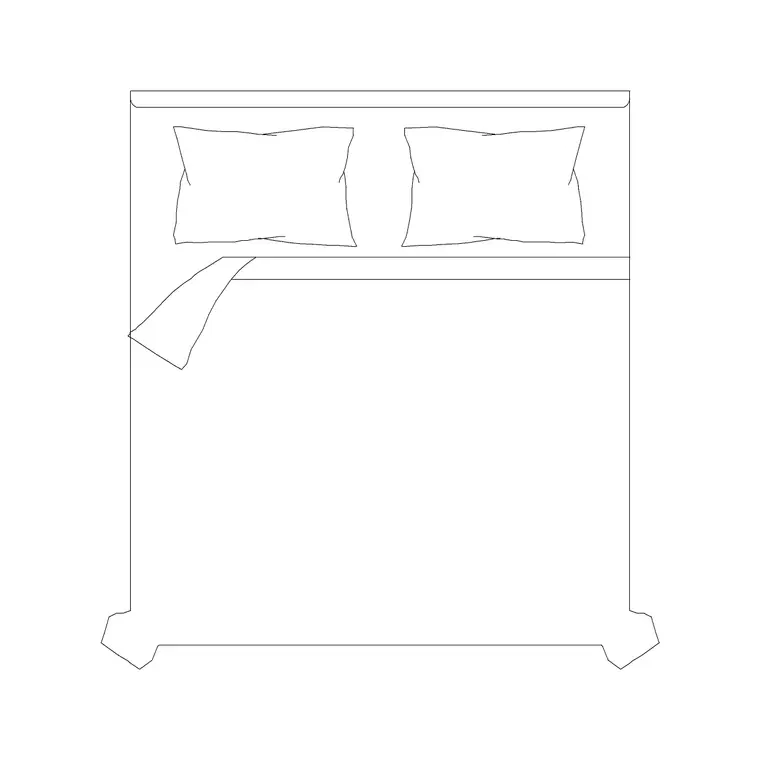
The round-up pairs naturally with the bed blocks in this furniture series — particularly the double bed drawn without side tables, which is designed to take your choice of bedside block on each side.
What the bedside-table round-up covers
The selection covers the small bedside pieces a bedroom uses. Simple square nightstands are the staple, sized to sit beside a headboard. Bedside cabinets add one to three drawers for storage and a slightly deeper footprint. Slim and wall-hung side tables suit tight rooms where a full cabinet would crowd the walkway. Round side tables give a softer read for contemporary or boutique-hotel schemes.
Each is drawn in plan as a compact footprint, often with the drawer fronts indicated, so the block reads clearly as a bedside unit and sits cleanly against the headboard line. Because they are small and you usually need a matched pair, the blocks are quick to insert and mirror to both sides of the bed.
Typical bedside-table dimensions
Design around these figures. A bedside table is commonly 400-500 mm wide and 350-450 mm deep — small enough to fit beside a bed without eating the side access. Height is usually set to match or sit just below the mattress top, around 500-650 mm, so a lamp and a glass of water are within easy reach. Slim wall-hung versions can be as shallow as 250-300 mm for very tight rooms.
The planning point is the gap: a bedside table needs only a small clearance to its sides, but it should not push into the access strip you need down the side of the bed. Drawn to scale, the block shows whether it fits the gap between the bed and the wall or wardrobe.
Placing bedside tables in pairs
Most bedrooms want a matched pair, one each side of the bed. Insert the first bedside table, snap it against the headboard wall beside the mattress, then mirror it across the bed centreline to place the second. Mirroring keeps the pair symmetrical and saves re-aligning a second block by hand. Where only one side has room — a bed against a wall — place a single table and leave the wall side clear.
Keep the bedside tables on the bedroom furniture layer with the bed and wardrobe so they freeze and thaw together. Because they are small, they are also the easiest furniture to lose track of, so a clear block name keeps the right nightstand one search away when you build a scheme.
Pairing bedside tables with the bed
The bedside table only makes sense in relation to the bed, which is why this round-up is built to pair with the bed blocks in the furniture series. A bed drawn without integrated side tables — like the double bed elsewhere in this series — gives you a clean headboard line to place your chosen bedside block against, so you can match the nightstand to the room rather than accept a fixed default.
A practical workflow is to set out the bed first, confirm the side access strips, then drop a bedside table into each gap and check it does not eat into that access. If a full cabinet crowds the walkway, swap to a slim wall-hung table; the scaled blocks let you test the swap in seconds and keep the circulation honest.
Plan footprint and the small-room test
Bedside tables are almost always a plan exercise, because their job is spatial: filling the gap beside the bed without blocking it. The block's footprint against the headboard wall is what you check. In a generous room any bedside table works; in a tight room the bedside table is often the piece that decides whether the layout holds together.
When a bedroom is squeezed, draw the bed and its side-access strips first, then test bedside tables of decreasing size — a full drawered cabinet, then a small nightstand, then a slim wall-hung shelf — until one fits the gap while leaving the access clear. Because every option is a scaled block, that test is a quick visual comparison rather than a series of measurements, and it stops a nightstand quietly stealing the walkway.
Where bedside-table blocks are used
Bedside tables appear in residential bedrooms, hotel and resort rooms, serviced apartments, student and care accommodation, and any sleeping space. Interior designers use them to balance and finish a bedroom scheme; architects use them to confirm a bed has proper side access; FF&E teams count them as part of the bedroom furniture package.
Use the bedside-table round-up with the bed, wardrobe and dressing-table blocks in this furniture series to lay out a complete bedroom from one consistent, free library. Scaled and licence-clear, the same nightstand carries from a concept layout to a coordinated furniture drawing, and mirrors cleanly to give you a matched pair every time.
Free download
Browse the full library — DWG & DXF, no signup.
Questions
Frequently asked
How big is a standard bedside table block?+
Commonly 400-500 mm wide and 350-450 mm deep, at a height of around 500-650 mm to sit near the mattress top. Slim wall-hung versions can be as shallow as 250-300 mm for tight rooms.
How do I place a matched pair quickly?+
Insert one bedside table against the headboard wall beside the mattress, then mirror it across the bed centreline to place the second. Mirroring keeps the pair symmetrical without re-aligning a second block by hand.
Which bed blocks pair with these bedside tables?+
They pair with the bed blocks in this furniture series, especially a bed drawn without integrated side tables, which leaves a clean headboard line to place your chosen bedside block against on each side.
Are the bedside-table CAD blocks free for commercial use?+
Yes. Every block downloads free in DWG and DXF with no signup, no watermark and no attribution requirement, and they are cleared for commercial project use.
Related downloads
Blocks for this guide

Related categories
Related guides
Curated pack
Free Bedroom CAD Block Pack — DWG & DXF
Free bedroom CAD block pack in DWG and DXF — double beds, side tables, wardrobes and seating in plan and side view for AutoCAD. No signup, commercial OK.
Curated pack
Free Living Room CAD Block Pack — DWG & DXF
Free living room CAD block pack in DWG and DXF — sofa sets, coffee tables, rugs and seating in plan for AutoCAD lounge layouts. No signup, commercial OK.
Curated pack
Free Wardrobe & Closet CAD Block Pack — DWG
Free wardrobe & closet CAD block pack in DWG and DXF — fitted, sliding and walk-in wardrobes in plan for AutoCAD bedrooms. No signup, commercial OK.