Explainer · object snaps autocad
Object snaps (OSNAP) explained
By Saumyajit Maity · Published 3 Apr 2026 · Updated 28 Apr 2026
Object snaps are the feature that makes AutoCAD precise rather than approximate. Without them, clicking 'on' the end of a line actually lands you somewhere near it, and your drawing slowly fills with gaps and overshoots that wreck dimensions, hatches and trims. Object snaps — OSNAP — magnetically pull your cursor to exact geometric points like the true endpoint of a line, the centre of a circle, or the intersection of two edges. They are arguably the most important precision tool in the whole program.
Most professionals draw with object snaps on constantly and barely think about them — which is exactly the goal. But the mechanism rewards understanding: there's a difference between snaps that are always active and snaps you invoke for a single pick, and a small set of snap modes covers almost everything you do. This page explains what object snaps are, the running-vs-override distinction, the key modes worth knowing, and the tracking features that build on them.
What an object snap does
An object snap constrains your next pick to a precise, meaningful point on existing geometry rather than a vague nearby spot. As you move the cursor near a line's end, AutoCAD shows a marker (a small square for Endpoint, a triangle for Midpoint, a circle for Centre, an X for Intersection) and a tooltip naming the snap. Click while the marker shows, and your point lands exactly on that geometric feature — to full database precision, not pixel-close.
This precision is what holds a drawing together. When a wall's endpoint snaps exactly to another wall's endpoint, they truly meet — no microscopic gap to break a hatch boundary or a trim. Object snaps are why a CAD drawing can be trusted to the millimetre, and why drawing without them produces files that look right but measure wrong.
Running snaps vs override snaps
There are two ways to use object snaps, and understanding both makes you efficient.
Running object snaps are the ones that stay permanently active. You set which modes are on in the Drafting Settings dialog (OSNAP command, or right-click the OSNAP status-bar button → Settings), tick the ones you want — typically Endpoint, Midpoint, Centre, Intersection — and from then on the cursor snaps to any of those as you hover. The F3 key toggles all running snaps on and off in one press.
An override (single-pick) snap is invoked for just one pick, overriding the running settings for that click only. You trigger it by Shift+right-click (which opens the snap menu) or by typing the snap's abbreviation mid-command — END for endpoint, MID for midpoint, CEN for centre, INT for intersection, PER for perpendicular. Overrides are how you reach a snap you don't keep running, or force a specific one when several are nearby. The pro pattern is a sensible set of running snaps plus overrides for the occasional special case.
The snap modes worth knowing
There are around a dozen modes, but a handful do most of the work:
- Endpoint — the exact end of a line, arc or polyline segment. The workhorse. - Midpoint — the exact middle of a segment. Great for centring. - Intersection — where two objects cross. (Apparent Intersection catches where they'd cross if extended.) - Centre — the centre of a circle, arc or ellipse. Hover over the edge to find it. - Quadrant — the 0°, 90°, 180°, 270° points of a circle. - Perpendicular — a point that makes your new line perpendicular to the object you snap to. - Tangent — a point that makes your line tangent to a circle or arc. - Node — snaps to a point object. - Nearest — the closest point actually on an object (use sparingly; it's deliberately imprecise). - Insertion — the insertion/base point of a block or text.
Endpoint, Midpoint, Centre and Intersection as running snaps, with Perpendicular, Tangent and Quadrant called as overrides, will carry you through almost any 2D drawing.
When to turn snaps off
Object snaps are usually a help, but occasionally they fight you. In a dense area with many objects close together, the cursor may keep grabbing the wrong point — snapping to a nearby endpoint when you wanted free space. When that happens you have options short of disabling everything: zoom in so the points separate, hold down a single override to force just the snap you want, or tap F3 to suspend running snaps for a pick or two.
There are also moments you genuinely want a non-precise point — sketching a freehand boundary, placing a note, roughing out a concept. Turning snaps off (F3) for those keeps the cursor from jumping to geometry you don't care about. The skill is knowing they're a toggle: on for precise construction, briefly off for the rare freehand task, then back on. Leaving them off permanently, though, is how gappy, untrustworthy drawings happen.
Object snap tracking and polar tracking
Two features build on object snaps to unlock alignment-based drawing. Object Snap Tracking (toggle with F11) lets you acquire one or more snap points and then draw along alignment paths derived from them — hover over an endpoint to 'acquire' it, move away, and a dotted tracking line extends from it so you can pick a point aligned horizontally or vertically with that endpoint. Acquire two points and you can find their intersection in mid-air without any construction lines.
Polar Tracking (F10) complements it by snapping the cursor direction to set angles (0°, 90°, 45°, or any increment you define) as you draw, showing a tracking vector and the distance. Together, running object snaps + object snap tracking + polar tracking let you draw precise, aligned geometry almost entirely by hovering and typing distances — no construction lines, no calculation. It's the combination experienced drafters lean on constantly, and it all rests on the object-snap foundation.
Snapping to blocks and inserted geometry
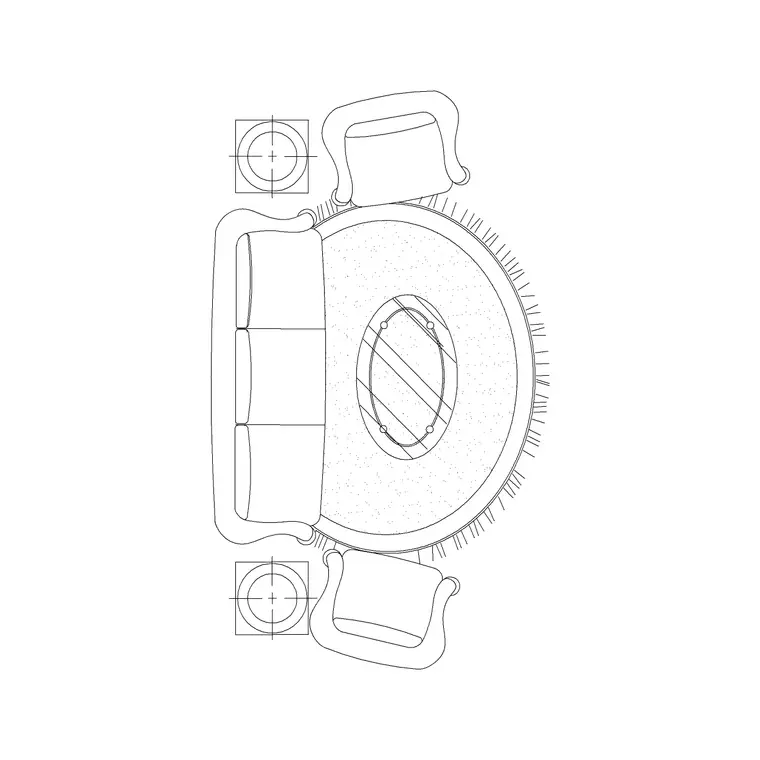
Object snaps work on blocks too, which matters when you're assembling a drawing from downloaded components. The Insertion snap grabs a block's base point — useful for aligning a stack of blocks or measuring from a known handle — while Endpoint, Midpoint and Centre snap to the visible geometry inside the block (the corner of a desk, the centre of a round table, the midpoint of a sofa's front edge).
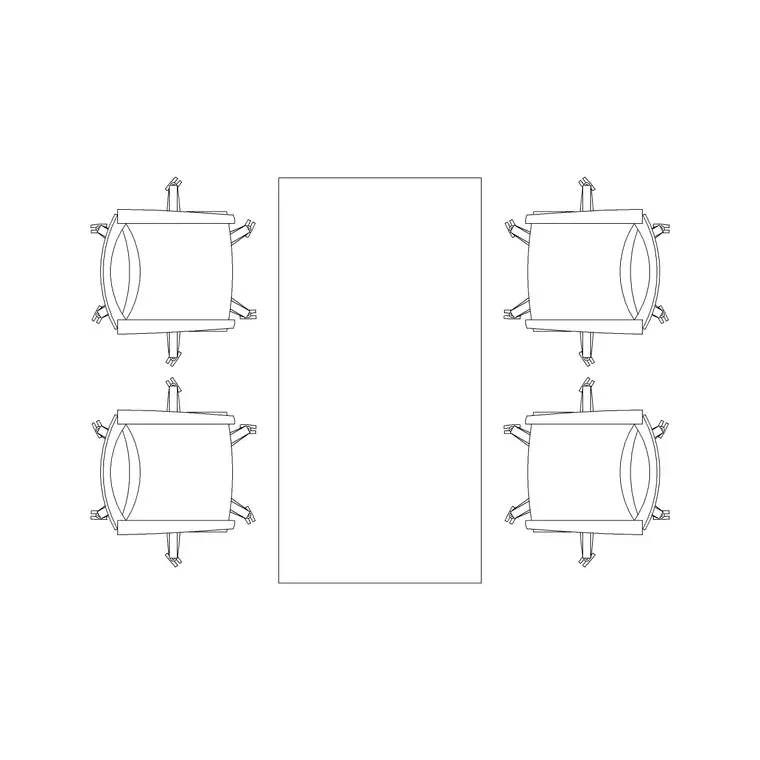
That's why a well-drawn block with a sensible base point is a pleasure to place: you snap its insertion point to a wall corner, then snap other geometry to its edges to line up neighbouring furniture precisely. When you populate an office layout with desk, chair and table blocks, object snaps are what let everything meet cleanly — chairs tucked exactly to a table edge, workstations aligned along a true line — rather than approximately. Precise blocks plus object snaps is how a furniture layout ends up coordinated rather than nearly-right.
Free download
Browse the full library — DWG & DXF, no signup.
Questions
Frequently asked
What is OSNAP in AutoCAD?+
OSNAP (object snap) is a precision feature that pulls your cursor to exact geometric points on existing objects — endpoints, midpoints, centres, intersections and more — so your picks land precisely rather than approximately. It's the main tool that keeps a CAD drawing accurate to the millimetre.
What's the difference between running and override object snaps?+
Running snaps stay permanently active (set in the OSNAP dialog, toggled with F3) and apply to every pick. An override snap is invoked for a single pick only — via Shift+right-click or typing an abbreviation like END or MID — overriding the running settings for that one click.
How do I turn object snaps on or off?+
Press F3 to toggle all running object snaps on or off, or click the OSNAP button on the status bar. To choose which snap modes are active, right-click that button and pick Settings, or run the OSNAP command to open the Drafting Settings dialog.
Why does my cursor keep snapping to the wrong point?+
Usually too many snap modes are running in a crowded area, so the cursor grabs the nearest of several points. Zoom in to separate the points, hold a single override snap to force the one you want, or briefly press F3 to suspend running snaps for that pick.
Related downloads
Blocks for this guide
Popular blocks to download
Related categories
Related guides
Explainer
AutoCAD Layers Explained — A Practical Guide in 2026
AutoCAD layers explained simply — what layers are, how to organise a drawing with them, the difference between Off, Freeze and Lock, and how layer 0 behaves with blocks.
Explainer
Layer Naming Standards: AIA & BS1192 Explained
Layer naming standards explained — how AIA, BS1192 and ISO 13567 structure CAD layer names, what each field means, and how to apply a consistent convention to your drawings.
Explainer
Lineweights in AutoCAD Explained — Set & Plot
Lineweights in AutoCAD explained — how to assign them ByLayer, why they don't always show on screen, the LWT and LWDISPLAY settings, and how plot styles control printed line thickness.