How-to guide · how to open a dwg in revit
How to open a DWG in Revit
By Sumana Kumar · Published 29 Apr 2026 · Updated 1 Jun 2026
A common Revit question is how to 'open' a DWG — and the honest answer is that you don't, not the way you open one in AutoCAD. Revit is a building-information modeller built around its own .rvt project files, so a DWG can't be opened as a Revit project. Instead you bring the DWG into a Revit project as a linked or imported reference, then use it as the base to build a real Revit model.
That distinction is the whole point of this guide. Once you understand that Revit treats a DWG as reference geometry rather than as an editable drawing, the workflow is clear: start or open a Revit project, link or import the DWG onto the right level with the correct units, and trace native Revit elements over it. Here's how, step by step, with the gotchas that snag newcomers from AutoCAD.
Why Revit can't open a DWG directly
AutoCAD and Revit solve different problems. AutoCAD draws lines; Revit builds an intelligent 3D model where a wall knows it is a wall, carries materials, and reports its area. There is no automatic way to turn flat DWG linework into intelligent Revit elements, so Revit never offers a 'File > Open' for DWG. The drawing has to be referenced into a project and rebuilt as model elements.
Understanding this saves frustration. People coming from AutoCAD expect to open the DWG and start editing; in Revit you instead open or create a project first, then attach the DWG inside it. The DWG becomes a tracing template, not the drawing you work in.
Step 1 — Open or start a Revit project
Launch Revit and either open an existing project or start a new one from an architectural template. You need a project (or a family) to receive the DWG — there is nowhere to put a CAD reference without one. Choose a template whose units match your work; for the millimetre DWG blocks here, a metric template keeps everything consistent.
Navigate to the plan view and level where the DWG belongs. If you are bringing in a ground-floor plan, open the Level 0 or Ground Floor plan view first, so when you place the DWG it lands in the right place in the model rather than floating on the wrong storey.
Step 2 — Link or import from the Insert tab
Go to the Insert tab. 'Link CAD' keeps a live link to the DWG so you can reload it if the source changes — best when the file belongs to a consultant or may be revised. 'Import CAD' embeds a static copy, fine for a one-off base you'll trace and bin. For most architectural tracing, importing is simplest; for coordinated multi-party projects, linking wins.
Select your DWG in the dialog and, before clicking Open, set the options along the bottom: import units, positioning and the target level. These mirror the DXF workflow because Revit handles DWG and DXF through the same importer. Set units to millimetres to match the blocks here, and choose 'Center to Center' or 'Origin to Origin' positioning depending on whether the file needs to align to a shared setting-out point.
Step 3 — Place it on the correct level and lock it
Use the 'Place at' option to drop the DWG onto the right level so it sits at the correct height in the model. Once it lands, it appears as a single selectable instance. Pin it (select it and use the Pin tool) so you can't accidentally drag it out of position while you trace — a misplaced base drawing throws off everything you model on top of it.
If the DWG came in faint, wrong-coloured or cluttered, open Visibility/Graphics (VG) and adjust its imported layers: halftone the whole thing so it reads as a guide, and hide the layers you don't need, like text and dimensions, leaving just the geometry you'll trace.
Step 4 — Trace Revit elements over the DWG
Now do the real work: build native Revit elements along the CAD lines. Use the Wall tool and snap to the DWG's wall lines, letting Revit's endpoint and intersection snaps lock onto the accurate CAD points. Add doors and windows by hosting them in those walls, place levels and grids to match, and the flat DWG becomes a proper 3D Revit model.
Because you are snapping to precise CAD geometry, your Revit model inherits the drawing's dimensional accuracy. Work through the plan systematically — perimeter walls, internal walls, then openings and components — so nothing is missed. The DWG is purely a guide; everything load-bearing in your project is the native Revit geometry you draw over it.
Step 5 — Remove or unload the DWG when finished
When the Revit model stands on its own, the DWG has done its job. If you linked it, open 'Manage Links', select the CAD file and unload or remove it — unloading keeps the option to bring it back if the source is revised. If you imported (embedded) it, just select the instance and delete it.
Clearing out the CAD keeps the project light and stops the import from printing or cluttering Visibility/Graphics lists later. A good habit is to keep imports on a dedicated workset or in clearly-labelled views so they are easy to find and purge. The finished Revit model should contain only native elements, with no leftover CAD riding along invisibly.
Free download
Browse the full library — DWG & DXF, no signup.
Questions
Frequently asked
Can Revit open a DWG file directly?+
No. Revit works in its own .rvt project format and cannot open a DWG as a project. You link or import the DWG into a Revit project (under the Insert tab) and use it as reference geometry to trace native Revit elements over.
How do I convert a DWG into a Revit model?+
There is no automatic conversion — flat CAD lines don't become intelligent Revit elements on their own. You link or import the DWG, then manually trace Revit walls, doors and components over it, snapping to the accurate CAD points.
Should I link or import a DWG in Revit?+
Link it if the file may be revised or belongs to a consultant, so you can reload updates via Manage Links. Import (embed) it for a one-off base you'll trace and delete. Importing is simplest for solo tracing work.
What units should I set when bringing a DWG into Revit?+
Match the DWG's units — millimetres for the blocks here — in the import dialog's units field. Setting it explicitly avoids the geometry landing at the wrong scale, the tell-tale sign being walls that should be metres arriving as millimetres.
Related downloads
Blocks for this guide
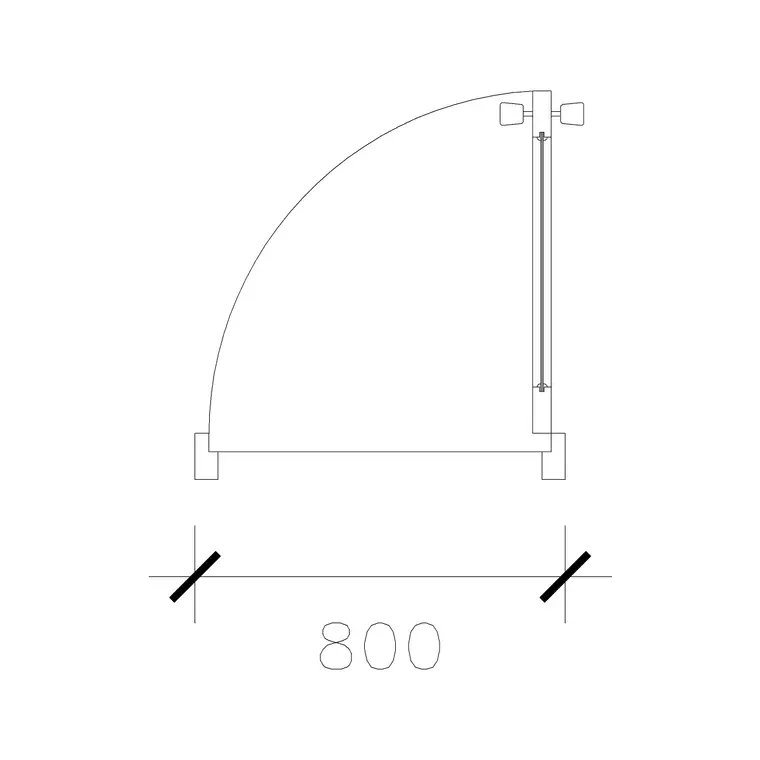

Popular blocks to download
Related categories
Related guides
How-to guide
How to Create a Block in AutoCAD (BLOCK & WBLOCK)
Learn how to create a block in AutoCAD with the BLOCK and WBLOCK commands — pick a base point, choose objects, set units, and save a reusable DWG block library.
How-to guide
How to Convert DWG to DXF in AutoCAD
Convert a DWG to DXF in AutoCAD with SAVEAS — choose the right DXF version, set precision, and export clean geometry for laser cutters, CNC and other CAD apps.
How-to guide
How to Convert DXF to DWG (3 Ways)
Convert a DXF to DWG three ways — in AutoCAD with SAVEAS, free with the ODA File Converter, or in DraftSight. Pick the right DWG version and keep layers intact.