How-to guide · how to import a dxf into revit
How to import a DXF into Revit
By Saumyajit Maity · Published 3 May 2023 · Updated 8 Mar 2026
Revit is a model-based program, not a line-based one, so bringing a DXF in works differently from AutoCAD or SketchUp. You are not adding the DXF to a drawing — you are placing a CAD reference into a Revit project or family, where it sits as a managed instance you can keep, reload or remove cleanly. Done right, a DXF gives you an accurate base to trace walls over, a detail to embed in a drafting view, or a profile to build a family from.
The two decisions that matter are whether to link or import, and which import units to set so the geometry lands at true size. This guide covers both, where in Revit each makes sense, and the housekeeping that keeps imported CAD from cluttering your model.
Decide first — link or import
Revit gives you two ways to bring CAD in, and the choice matters more than in other software. 'Link CAD' keeps a live connection to the external DXF file: if the source file changes, you reload and Revit updates the reference. 'Import CAD' embeds a static copy that no longer tracks the original. For a base drawing you'll trace over and then discard, importing is fine; for a consultant's drawing that may be revised, linking is safer because you can pull in their updates.
Both live under the Insert tab. Pick Link CAD for anything that might change or that someone else owns; pick Import CAD for a one-time reference you control. Whichever you choose, the units and placement options that follow are the same.
Step 1 — Open the dialog and find your DXF
Go to the Insert tab and click 'Link CAD' or 'Import CAD'. In the dialog, set the file-type filter to DXF so your file appears, and select it. Don't click Open yet — the row of options along the bottom of this dialog controls how the DXF lands, and they are easy to miss.
The key fields are 'Import units', 'Positioning', the level or 'Place at' control, and the 'Colors' and 'Layers' options. Set these deliberately. Revit, more than most programs, rewards getting the placement right at import because moving CAD around afterwards is fiddlier than in a line-based CAD app.
Step 2 — Set import units and positioning
Set 'Import units' to match the DXF — millimetres for the blocks here. If you leave it on 'Auto-Detect' Revit usually guesses correctly from the file, but setting it explicitly removes the risk of a block arriving at the wrong scale. A wall that should be three metres landing as three millimetres is the unmistakable sign the units were wrong.
For positioning, 'Auto - Center to Center' drops the DXF in the middle of your view, which is the easy default for a base you'll move anyway; 'Auto - Origin to Origin' aligns the DXF's origin to Revit's, which matters when several files must share a common setting-out point. Tick 'Place at' to put the import on the correct level so it sits at the right height in the model.
Step 3 — Place it in the right view or family
Where you import depends on what the DXF is for. To trace a floor plan, import it into the corresponding plan view at the right level, then draw Revit walls along the CAD lines. To embed a 2D detail, import into a drafting view, where the linework becomes a permanent detail not tied to the 3D model. To build a family from a profile — a door panel, a custom section — import the DXF into the Family Editor and use it as the sketch reference.
Matching the import to its purpose keeps the model clean. A floor plan belongs on its level; a generic detail belongs in a drafting view; a profile belongs in a family. Importing everything into the project at large is what leads to CAD clutter you later have to hunt down.
Step 4 — Trace, then control visibility
Once the DXF is placed, treat it as a tracing guide rather than the finished work. Snap Revit walls, lines and components to the CAD endpoints and intersections so your model inherits the drawing's accuracy. The CAD import sits on its own — you can select it as a single instance and lock it so you don't nudge it while you work.
Control its visibility through the imported layers. In Visibility/Graphics (type VG), the imported DXF appears with its CAD layers listed, so you can fade, hide or recolour individual layers — hide the dimensions and text, keep the wall lines, for example. Halftone the whole import so it reads as a faint guide beneath your crisp Revit geometry.
Step 5 — Clean up when you're done
When the tracing is finished, remove or hide the CAD so it doesn't bloat the model or print by accident. If you imported (embedded) it, select the instance and delete it, or run 'Manage Links' for linked CAD to unload or remove the reference. Leaving stale imports in a project is a common source of slow files and cluttered Visibility/Graphics lists.
A tidy habit is to keep all CAD imports on a dedicated workset or in clearly-named drafting views so they are easy to find and purge later. If you used a linked DXF, you can simply unload it once the model stands on its own, keeping the option to reload it if the source drawing is revised.
Free download
Browse the full library — DWG & DXF, no signup.
Questions
Frequently asked
Should I link or import a DXF in Revit?+
Link a DXF if the source file might be revised or belongs to someone else, so you can reload updates. Import (embed) it for a one-time base you control and will trace over then delete. Both are under the Insert tab.
What import units should I use for a DXF in Revit?+
Match the DXF's units — millimetres for the blocks here. Set 'Import units' explicitly in the import dialog rather than relying on Auto-Detect, so the geometry lands at true size instead of a thousand times too big or small.
Can I use a DXF to build a Revit family?+
Yes. Import the DXF into the Family Editor and use it as a sketch reference — trace its profile to build the family geometry. This is a common way to create custom door panels, sections and other profiles from CAD linework.
How do I hide CAD layers after importing into Revit?+
Open Visibility/Graphics (type VG) and find the imported file's layers under the Imported Categories tab. You can hide, halftone or recolour individual CAD layers — hide dimensions and text, keep the wall lines as a tracing guide.
Related downloads
Blocks for this guide
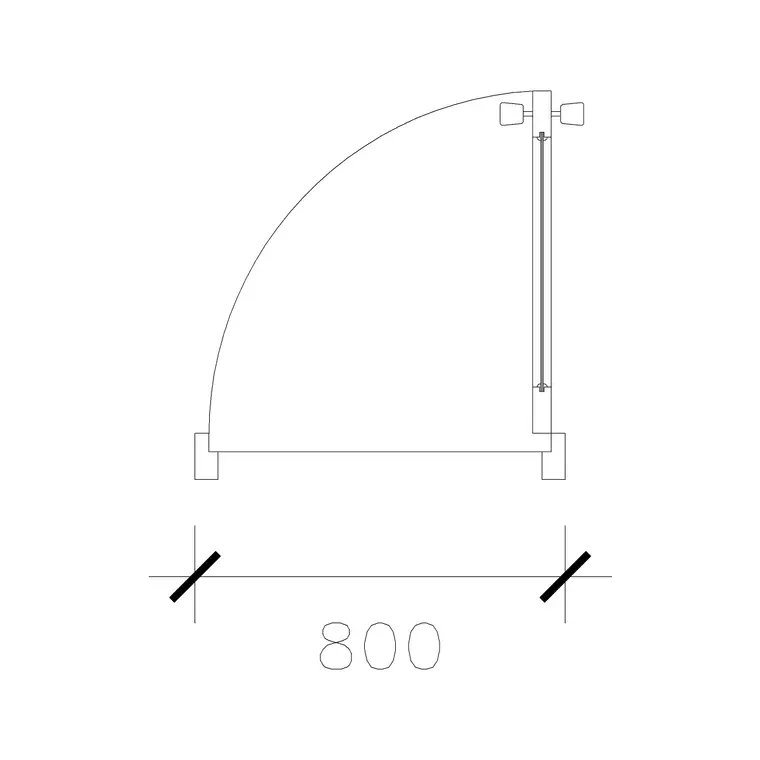

Popular blocks to download
Related categories
Related guides
How-to guide
How to Create a Block in AutoCAD (BLOCK & WBLOCK)
Learn how to create a block in AutoCAD with the BLOCK and WBLOCK commands — pick a base point, choose objects, set units, and save a reusable DWG block library.
How-to guide
How to Convert DWG to DXF in AutoCAD
Convert a DWG to DXF in AutoCAD with SAVEAS — choose the right DXF version, set precision, and export clean geometry for laser cutters, CNC and other CAD apps.
How-to guide
How to Convert DXF to DWG (3 Ways)
Convert a DXF to DWG three ways — in AutoCAD with SAVEAS, free with the ODA File Converter, or in DraftSight. Pick the right DWG version and keep layers intact.