How-to guide · how to import a dwg block into sketchup
How to import a DWG block into SketchUp
By Saumyajit Maity · Published 28 Jan 2026 · Updated 9 Apr 2026
SketchUp and AutoCAD work together constantly: architects draw a plan in CAD, then import it into SketchUp as the flat base to model walls and massing over. Bringing a DWG block in is straightforward, but two things catch people out — the units setting at import, which decides whether your block arrives the right size, and the fact that CAD linework comes in as loose edges that you usually want to wrap into a component.
This guide covers the import dialog and its units option, what actually arrives on screen, how to turn the imported block into a clean, reusable component, and how to use a 2D plan-view block as the footprint you build a 3D model on. Note that DWG import is a SketchUp Pro feature; the free web version does not import DWG.
Step 1 — Start the import and open the options
In SketchUp Pro, go to File > Import. In the file dialog, set the file-type filter to 'AutoCAD Files (*.dwg, *.dxf)' so your block shows up, then select it. Before clicking Import, click the 'Options' button — this is where the conversion is actually controlled, and skipping it is the single most common reason a block comes in at the wrong size.
The options dialog lets you set the import units and a few geometry-cleanup choices. Get these right now and the rest of the import is painless; ignore them and you will spend the next ten minutes rescaling and welding.
Step 2 — Set the import units to match the DWG
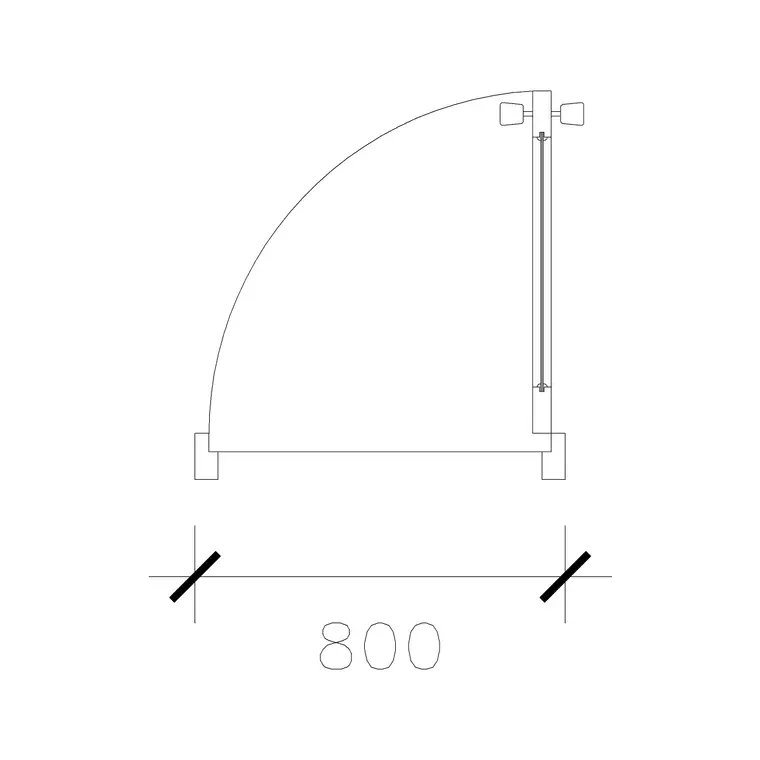
The units dropdown is the critical control. The DWG blocks here are drawn in millimetres, so set the import units to Millimeters. If you choose the wrong unit, SketchUp interprets the numbers in the file as a different scale and the block arrives a thousand times too big or too small — the classic 'where did my model go?' moment after import.
If you are unsure what units a DWG uses, a 3000-unit wall that should be three metres tells you it is millimetres; the same wall as 3 units means metres, and 118 units means inches. Match the import unit to that and the block lands at true size, sitting correctly alongside anything already in your model.
Step 3 — Bring it in and see what arrived
Click OK on the options, then Import. SketchUp processes the file and drops the geometry into your model; click once to place it, or it lands at the origin. A 2D plan-view block arrives as flat linework lying on the ground plane (the red-green plane), which is exactly what you want as a base to build on.
What you get is edges and faces, not AutoCAD blocks — SketchUp does not keep AutoCAD's block definitions, it converts the geometry. The whole import is automatically grouped as a single component so it does not stick to everything else you draw, which is genuinely helpful: you can move it, lock it and trace over it without disturbing it.
Step 4 — Make it a clean, reusable component
The import comes in as one component already, but it is worth tidying. Double-click to enter it, and if edges look broken or faces did not form, that is normal for CAD linework — it imports as edges only and you may need to retrace a face or two to get a surface SketchUp can push-pull. Keep the CAD base on its own layer (tag) so you can hide it once you have modelled over it.
If you will reuse the block — a door, a piece of furniture, a fixture — right-click and confirm it is a component (not just a group) and give it a clear name in the Components panel. Components update together when you edit one, so a door you import once and place ten times stays editable in a single place, just like a block in AutoCAD.
Step 5 — Build 3D over the 2D block
With a plan-view block placed flat on the ground, you have a precise, to-scale footprint to model from. Trace the wall lines with the Line or Rectangle tool to create faces, then Push/Pull them up to wall height. Snap to the imported endpoints and intersections — they are accurate CAD points, so your 3D model inherits the plan's precision rather than your freehand.
Lock or hide the CAD layer once the 3D is roughed in so you don't accidentally grab the flat linework while modelling. This 'import the plan, trace it, push it up' workflow is the backbone of architectural SketchUp modelling, and starting from a correctly-scaled DWG block is what makes the resulting model dimensionally trustworthy.
Common SketchUp import problems
Three issues come up repeatedly. Wrong scale is almost always the units setting from step 2 — if it happens, undo, re-import, and fix the unit. Missing faces are expected: CAD gives SketchUp edges, and faces only form when edges are coplanar and closed, so retrace or use a face-creation extension on stubborn outlines.
The third is a heavy, sluggish model from importing too much CAD detail — a full, hatched, dimensioned drawing brings in thousands of edges you don't need for massing. Before importing, clean the DWG down to just the linework you'll model from (in AutoCAD, isolate the walls and key blocks, delete hatches and dimensions, and export that), so SketchUp gets a lean base instead of a noisy one.
Free download
Browse the full library — DWG & DXF, no signup.
Questions
Frequently asked
Why is my DWG block huge or tiny after importing into SketchUp?+
It is the import units setting. In File > Import, click Options and set the units to match the DWG — millimetres for the blocks here. The wrong unit makes SketchUp read the numbers at a different scale, so the block arrives far too big or small.
Can the free web version of SketchUp import DWG?+
No. DWG and DXF import is a SketchUp Pro feature. The free web version cannot import CAD files, so you need SketchUp Pro (or a workaround like converting the geometry to a supported format) to bring a DWG block in.
Does SketchUp keep my AutoCAD blocks as blocks?+
Not as AutoCAD blocks. SketchUp converts the geometry to edges and faces and groups the whole import as one component. You can then make parts into SketchUp components for reuse, which behave similarly but are SketchUp's own format.
Why didn't faces form when I imported my 2D block?+
CAD linework imports as edges only; SketchUp creates faces only where edges are coplanar and form a closed loop. Retrace an edge of the outline with the Line tool to trigger face creation, or use a face-builder extension for complex shapes.
Related downloads
Blocks for this guide
Popular blocks to download
Related categories
Related guides
How-to guide
How to Create a Block in AutoCAD (BLOCK & WBLOCK)
Learn how to create a block in AutoCAD with the BLOCK and WBLOCK commands — pick a base point, choose objects, set units, and save a reusable DWG block library.
How-to guide
How to Convert DWG to DXF in AutoCAD
Convert a DWG to DXF in AutoCAD with SAVEAS — choose the right DXF version, set precision, and export clean geometry for laser cutters, CNC and other CAD apps.
How-to guide
How to Convert DXF to DWG (3 Ways)
Convert a DXF to DWG three ways — in AutoCAD with SAVEAS, free with the ODA File Converter, or in DraftSight. Pick the right DWG version and keep layers intact.