How-to guide · how to draw a door in plan in autocad
How to draw a door in plan in AutoCAD
By Saumyajit Maity · Published 24 Jun 2026 · Updated 28 Jun 2026
Every floor plan is full of doors, and a correctly drawn door tells a reader three things at once: where the opening is, which way the leaf swings, and how much floor the swing eats. Get any of those wrong and the plan misleads whoever builds from it. The good news is that a plan door is a tight little recipe — break the wall, draw the leaf, sweep the arc — and once you have done it a few times it takes under a minute.
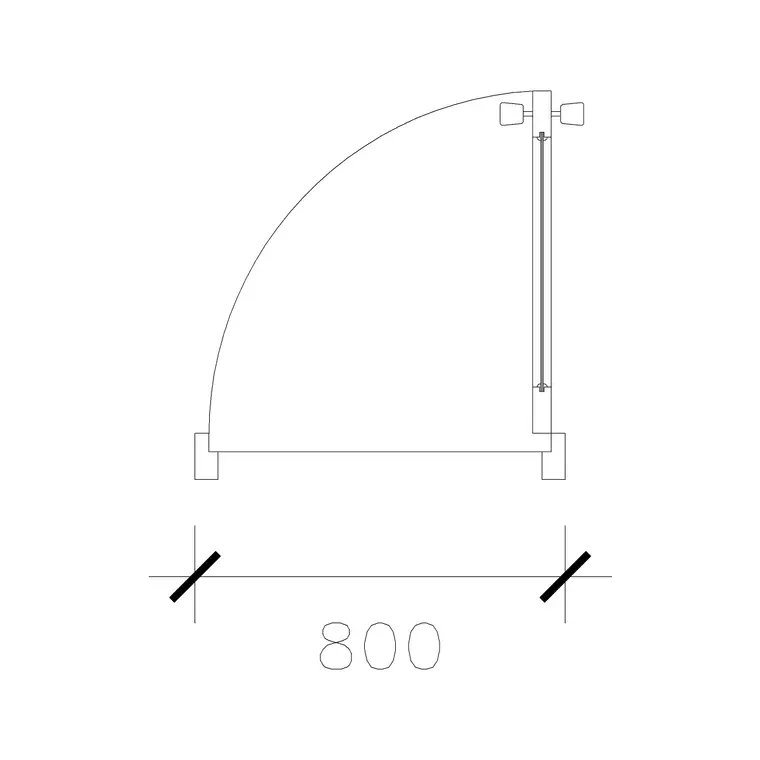
This guide draws a single hinged internal door as the worked example, since that is the most common case. The same method covers external doors, double doors (two leaves and two arcs) and the swing direction that determines whether a door opens into or out of a room. If you would rather place a ready-made one, the doors category has scaled door blocks with the frame and swing already drawn.
Step 1 — Decide the opening width
A door starts as a gap in a wall, so first fix the clear opening. Internal doors are commonly 700–900 mm wide, with 800 mm a sensible default for a habitable room and 700–750 mm acceptable for a cupboard or small WC. External and main entrance doors run wider, often 900–1000 mm, and accessible doors need a larger clear width still. The opening you draw should be the structural gap, with the frame sitting inside it.
Decide the width before you cut the wall, because the leaf length, the arc radius and the clearance the door needs all follow from it. Drawing to a real width from the start means the swing you draw next is the swing the finished door will actually have.
Step 2 — Break the wall for the opening
With the opening width chosen, create the gap in the wall lines. Use OFFSET to mark the two jamb positions, then TRIM or BREAK to remove the wall segment between them, leaving a clean opening the width of the door. Cap the ends if your wall convention shows jamb lines.
Keep both wall faces broken squarely so the opening is exactly the width you intend — a sloppy break leaves the door looking like it does not fit its hole. If your walls are drawn as a single polyline or a wall object, use the relevant trimming or door-insert tool for that workflow, but the principle is the same: a clean gap the width of the door.
Step 3 — Draw the door leaf
Now draw the leaf — the panel itself — as a thin rectangle hinged at one jamb. Make its length equal to the opening width and its thickness a token 40–50 mm so it reads as a solid panel rather than a single line. Draw it in the open position, perpendicular to the wall, so it stands at ninety degrees into the room it serves.
The hinge end sits exactly on one jamb; the latch end projects into the room. Which jamb you hinge from, and which side of the wall the leaf falls on, together set the swing direction — and that is a real design decision, not a cosmetic one, because it controls whether the door fouls furniture, light switches or another door.
Step 4 — Add the swing arc
The arc is what makes the symbol unmistakably a door. Use the ARC command, pick the hinge point as the centre, snap the start to the latch corner of the open leaf, and sweep ninety degrees to where the closed door would sit against the frame. The arc traces the path the latch edge follows as the door swings shut.
Draw the arc on the same layer as the door, lighter than the wall so it reads as a notation rather than built fabric. This quarter-circle is the part a coordinator checks against everything nearby — it shows the clear floor the door demands, so it must be accurate, not approximate.
Step 5 — Mirror for the opposite hand
Doors come in left-hand and right-hand versions, and you will need both across a plan. Rather than redraw, select the finished door and run MIRROR about the centreline of the opening to flip the hand, or mirror about the wall line to swing it into the opposite room. Check the result against the room: a bedroom door usually swings into the bedroom, a WC door into the WC, and a door should never swing across a corridor where it blocks the route.
This is also where saving the door as a block pays off. Build one good door, then mirror and rotate instances around the plan, and you keep every door consistent while controlling each one's hand and swing individually.
Step 6 — Make it a block and tag it
Turn the finished door — opening, leaf and arc — into a block with BLOCK so you can reuse it. Pick the hinge point as the base point, since that is the natural handle for placing and mirroring. Name it clearly, such as DOOR-SINGLE-800, and set the block unit to millimetres.
If you add an attribute for a door reference number, you can later extract a door schedule straight from the drawing — a count of every door, its width and its type — which is exactly the data a builder or a fit-out package needs. Write the door out with WBLOCK to reuse it across projects, or just download a scaled door block and skip the drawing entirely.
Common mistakes with plan doors
The classic error is the missing or wrong swing arc — a door drawn as just a leaf, or with an arc that does not match the hinge, so a reader cannot tell which way it opens. Always anchor the arc on the hinge and sweep a true ninety degrees. The second mistake is a swing that clashes: a door arc that overlaps another door, sweeps over a radiator, or blocks a corridor. The whole point of drawing the arc is to catch those clashes early, so check it against neighbours.
A third slip is an opening that does not match the leaf — a 900 mm gap with a 700 mm door floating in it. Keep the opening, the leaf length and the arc radius all tied to the same width, and the door reads correctly every time.
Free download
Browse the full library — DWG & DXF, no signup.
Questions
Frequently asked
How wide should a door be in a floor plan?+
Internal doors are usually 700–900 mm wide, with 800 mm a good default. Cupboards and small WCs can be 700–750 mm, while external and entrance doors run 900–1000 mm. Draw the opening, leaf and swing arc all to the same width.
How do I draw a door swing in AutoCAD?+
Use the ARC command. Pick the hinge point as the arc centre, snap the start to the latch corner of the open leaf, and sweep ninety degrees to the closed position. The arc shows the floor area the door needs to open.
How do I change which way a door opens?+
Use MIRROR. Mirror the door about the opening centreline to switch the hand (left to right), or about the wall line to swing it into the opposite room. Always check the swing does not block a corridor or clash with furniture.
Should the door leaf be a single line or a rectangle?+
Draw it as a thin rectangle about 40–50 mm thick rather than a single line, so it reads as a solid panel. Draw it in the open position, perpendicular to the wall, hinged at one jamb with the latch edge projecting into the room.
Related downloads
Blocks for this guide
Popular blocks to download
Related categories
Related guides
How-to guide
How to Create a Block in AutoCAD (BLOCK & WBLOCK)
Learn how to create a block in AutoCAD with the BLOCK and WBLOCK commands — pick a base point, choose objects, set units, and save a reusable DWG block library.
How-to guide
How to Convert DWG to DXF in AutoCAD
Convert a DWG to DXF in AutoCAD with SAVEAS — choose the right DXF version, set precision, and export clean geometry for laser cutters, CNC and other CAD apps.
How-to guide
How to Convert DXF to DWG (3 Ways)
Convert a DXF to DWG three ways — in AutoCAD with SAVEAS, free with the ODA File Converter, or in DraftSight. Pick the right DWG version and keep layers intact.