How-to guide · how to change a block insertion point autocad
How to change a block's insertion point or base point
By Saumyajit Maity · Published 21 May 2026 · Updated 15 Jun 2026
A block's insertion point — its base point — is the handle AutoCAD grabs it by when you place it. Pick it well and the block snaps exactly where you intend every time; pick it badly and you spend every insertion nudging the block into position. This guide shows how to change the base point of a block, whether you are fixing one you downloaded, correcting one you made, or just want it to insert by a more useful handle.
The base point is set when the block is defined, so changing it means editing the definition rather than the placed instances. We will cover the clean route through the Block Editor, the BASEPOINT command that lives inside it, and the alternative of redefining the block from scratch. We will also look at where to put the base point for common block types, because the right handle depends entirely on how you place the thing — a door inserts best by its hinge, a column by its centre, a title block by a corner.
Why the base point matters so much
The base point is the single most underrated property of a block, because it decides how the block feels to use. When you insert a block, your cursor holds it by the base point and you click to drop that point onto the drawing. If the base point sits somewhere unhelpful — out in empty space, or at a corner you never align to — every insertion becomes a fight.
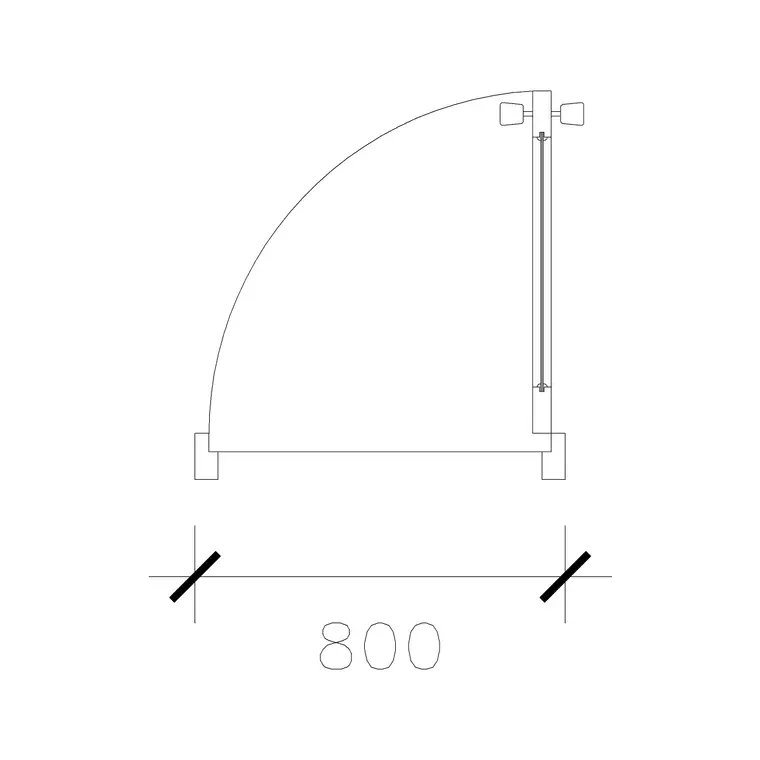
A well-placed base point lets you snap the block straight onto the geometry that governs its position. A door wants its base point at the hinge so it lands on the wall opening. A north arrow wants it at the tip or centre. A piece of furniture often wants its base point at the centre so it rotates predictably. Getting this right turns insertion from a place-then-adjust chore into a single confident click.
The clean way — change it in the Block Editor
The reliable route is the Block Editor, which edits the block definition directly so every existing and future instance updates together.
Type BEDIT (or BE) and press Enter, choose the block from the list, and click OK. The drawing switches to the Block Editor environment with the block's geometry shown around the origin (0,0). The origin is the base point. To move the base point, you move the geometry relative to the origin: select all the geometry and use MOVE so that the point you want as the new base sits on 0,0. Alternatively, place a Base Point parameter (from the Block Authoring Palettes) at the desired handle. When you close and save the editor, the block's base point is the new point and all instances re-anchor to it.
Using the BASEPOINT command inside BEDIT
There is a dedicated command for this that avoids fiddly MOVE arithmetic. Inside the Block Editor, type BASEPOINT and press Enter, then click the exact point you want to become the block's insertion handle — snap to a hinge, a corner, a centre.
BASEPOINT drops a Base Point parameter at that location, which AutoCAD treats as the block's insertion point from then on. It is the most direct method: open BEDIT, run BASEPOINT, snap to the right spot, then close and save. One caveat — if the block already has an explicit Base Point parameter, the new one replaces it, so you do not end up with two competing handles. After saving, re-insert the block and you will feel the difference immediately as it grabs by the new point.
Redefining the block from scratch as an alternative
If you would rather not use the Block Editor, you can redefine the block by re-running BLOCK with the same name.
Explode one instance of the block (or work from a copy of its geometry), then type BLOCK, enter the block's existing name, click 'Pick point' and snap to the base point you actually want, select the geometry, and click OK. AutoCAD warns that a block of that name already exists and asks whether to redefine it — say yes. Every instance in the drawing updates to the new definition, including the new base point.
This route is handy when you are also tidying the geometry or changing layers at the same time, since you are rebuilding the definition anyway. Just be careful to select exactly the same geometry so you do not accidentally drop part of the block.
Where to put the base point for common blocks
Choosing the handle is a small design decision that pays off across a project. A few sensible conventions:
- Doors: at the hinge point, so the block lands on the wall opening and swings correctly. - Windows: at one jamb or the centre of the sill, to align with the wall. - Columns: at the centre, so they sit on a grid intersection. - Furniture: usually the centre, so the piece rotates around itself. - North arrows and symbols: the centre or the tip, whichever you align to a sheet. - Title blocks: the bottom-left corner (0,0), so they register to the sheet edge.
The test is simple: ask 'what point on this block do I align to something else when I place it?' Put the base point there, and insertion becomes a single snap to the governing geometry.
Common pitfalls when changing the base point
A few traps catch people out. First, editing a placed instance is not the same as editing the definition — moving an inserted block does not change its base point; you must edit the definition through BEDIT or by redefining. Second, when you move geometry in the Block Editor to reposition it on the origin, every existing instance shifts by the same amount, which can leave placed blocks looking misaligned until you nudge them; expect that and check your instances after saving.
Third, if a block has a stored base point parameter and you also rely on the origin, the parameter wins, so make sure you are changing the one that is actually controlling placement. Finally, save the block out with WBLOCK if you want the corrected base point to travel to other drawings — fixing it in one file does not update your library copy unless you re-export it.
Free download
Browse the full library — DWG & DXF, no signup.
Questions
Frequently asked
Can I change a block's base point without exploding it?+
Yes. Use the Block Editor: type BEDIT, choose the block, then run BASEPOINT and snap to the new handle, or move the geometry so your chosen point sits on the origin. Save and close — every instance re-anchors. No need to explode anything.
Why doesn't moving the inserted block change its insertion point?+
Moving a placed instance only relocates that copy; the base point is a property of the block definition, not the instance. To change it you must edit the definition through BEDIT or redefine the block with BLOCK using the same name.
What's the best base point for a door block?+
The hinge point. With the base point at the hinge, the door inserts directly onto the wall opening and swings the right way, so you place it with a single snap instead of nudging it into the reveal afterwards.
Will changing the base point move blocks already in my drawing?+
Editing the definition re-anchors every instance to the new base point, which can shift placed copies. Check your instances after saving the editor and nudge any that moved. To keep the fix for other drawings, re-export the block with WBLOCK.
Related downloads
Blocks for this guide

Popular blocks to download
Related categories
Related guides
How-to guide
How to Set Drawing Units for CAD Block Downloads
Set your AutoCAD drawing units to match a downloaded CAD block before you insert it. Covers UNITS, insertion scale, mm vs m templates and the units checklist.
How-to guide
Fix a CAD Block That Inserts Too Big or Too Small
Block came in 1000x too big or microscopic? Diagnose and fix a CAD block that inserts at the wrong size — units mismatch, scale factors and a permanent fix.
How-to guide
How to Set INSUNITS in AutoCAD (Insertion Units)
Set INSUNITS in AutoCAD so blocks rescale automatically on insertion. Full value codes, the UNITS dialog, INSUNITSDEFSOURCE and how it controls scaling.